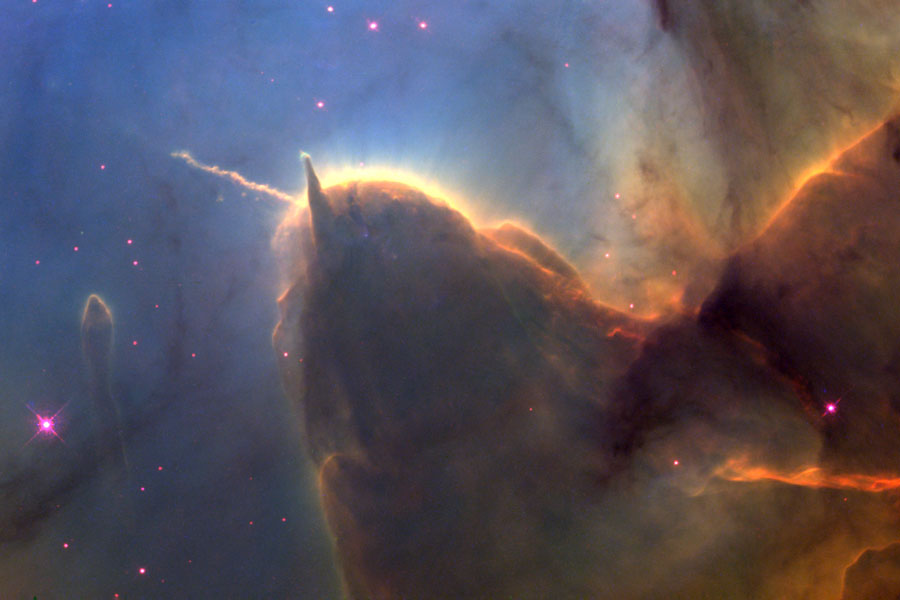
Dust pillars in the Trifid Nebula. Now here’s where a powerful vacuum cleaner would really be handy.

Dust pillars in the Trifid Nebula. Now here’s where a powerful vacuum cleaner would really be handy.

Actually, this is from 2005, but, following the sun from rising to setting on Dec. 22 that year, it’s a good reflection of today’s event as well: the official start of winter here in the northern hemisphere.

A pre-Christmas surprise from Comet 8P Tuttle, on Saturday, the 22nd, could bring us dozens of meteors an hour. Binocular photo of the comet and its attendant meteor dust by Chris Schur of Payson, AZ
"’We could be in for a merry surprise…when Earth passes through a trail of comet dust,’ astronomer Peter Jenniskens of the SETI Institute [tells spaceweather.com.] Previous returns of Comet Tuttle to the inner solar system have been attended by outbursts of meteors, most recently in 1980 and 1994."
The peak will be in the late afternooon, central time over North America, so you won’t see much then. But there should be some as late as 8 p.m. But you’ll need dark skies, as far from city lights as you can get. Look north after sunset.

Another potential weekend jaunt— just 7,000 light-years away in the constellation Casseopeia.

So the Earth is dependent upon the sun. You knew that. But did you know that the Earth is not just dependent upon the sun, but is actually roped to the sun? Giant magnetic ropes attach the Earth’s upper atmosphere directly to the sun–wherein we get, for instance, these Northern Lights over Alaska last March.
Comments Off on Magnetic ropes
Posted in Science/Engineering, Space
Tagged magnetic ropes, THEMIS satellites

A humbling view for the Earth-centric (aren’t we all?), taken by the HDTV camera aboard a lunar-orbiting Japanese robot satellite out in the black. It’s mapping the moon in high-definition for possible future Japanese landings.















 THE TEXAS SCRIBBLER
