Monthly Archives: April 2011

Texas and Israel, a lot alike

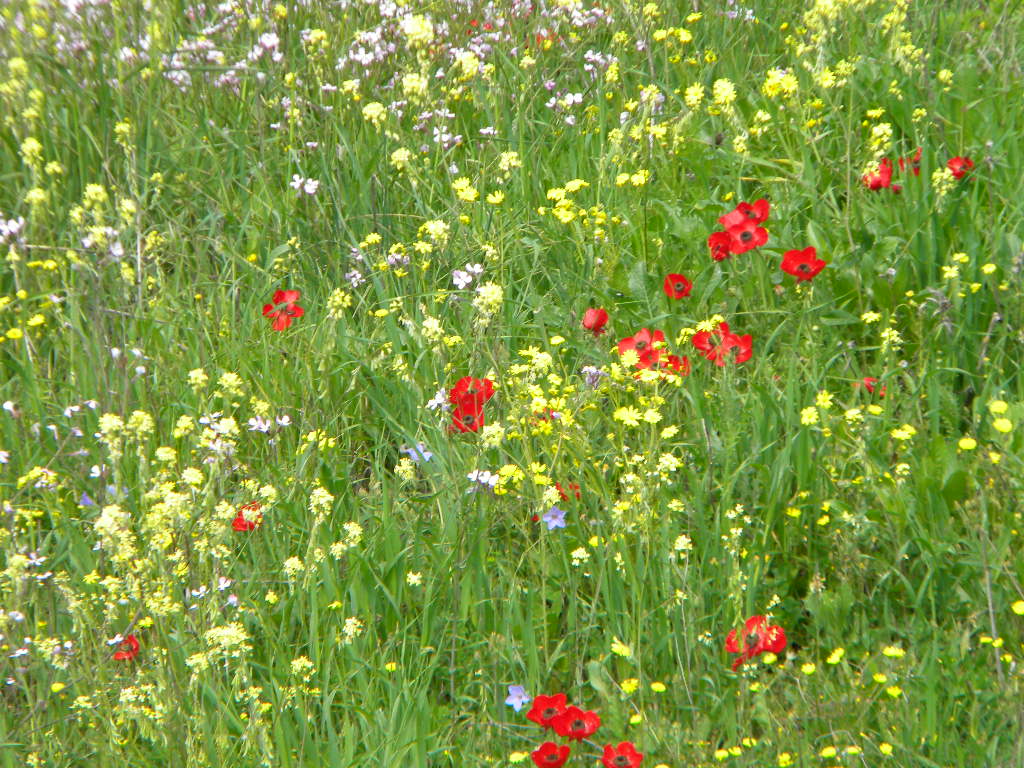
These wildflowers on the Golan Heights this time of year remind me how much alike the Texas hill country and Israel are, because we’re approximately on the same latitude and our climates are similar. Our wildflowers also are coming out all over, and although it’s getting steadily warmer, an occasional cold front  still blows through every now and then.

The Golan’s wind was icy on March 29, when we spent the night up there in a Moshav’s (religious community’s) B&B. The overhead lights in my unit quit late in the evening, but the room heaters kept working. Thankfully.

It was like the Davis Mountains of West Texas, except that the Golan is a three thousand feet higher in elevation than the rest of Israel. The Davis Mountains, which are suffering wild fires this spring due to our severe drought, are between five and six thousand feet above sea level.

Chicken on the highways

One thing that held my attention when I was in Israel was the way cars, even cars and pedestrians, at times played a brand of slow-motion chicken that usually had me wondering who would hit who first.

Nobody did. Not while I was watching. But a few came close. You’d never know that pedestrians have the right of way, or that cars entering a traffic circle (called a “roundabout” in Brit speak) are supposed to let the folks already in the circle go first. Sometimes they do. Sometimes they don’t. Depends on who chickens out.

Even this travel site acknowledges the situation, somewhat: “Israeli drivers have little if any patience and the driving culture can be referred to as wild.”

I came home thinking, yeah, I could rent a car and drive there. But I might want to practice rolling-stops first. And gut up for playing chicken.

Chicken and salad

The chicken is usually grilled. The salads are enormous. Together they constitute what seems to be the national dish of Israel. You can get steak, of course, from Golan Heights herds, and fish from the Red Sea. But chicken and salad are more common.

And when I say salad, I don’t mean lettuce. It’s available, sure, but more common is a mound of diced cucumbers, tomatoes, onions and parsley. A heaping mound. Pita bread and humus. A scoop of tahini in the middle of the humus ring. Mineral water. Diet coke. Cafe botz, or espresso. Yummy stuff, I tell you.

The god obsessed

It’s fashionable nowadays, particularly in the entertainment and news industries, to deride religious fundamentalists as mad. I have always had a certain affection for the god obsessed, having been down that road myself. Like the fellow in the center of this picture at the tomb of the Rambam in Tiberias, Israel, on the Kinneret, or Sea of Galilee.

In full Orthodox regalia, he was seated beside the tomb praying when we walked up to get a better look at the final resting place of the famous 12th century sage, Maimonides.

The fellow looked up and said in Hebrew that he was directly in touch with the soul of Maimonides. My secular Israeli friend backed up and urged me not to photograph the tomb at close range. The fellow, he said, was surely crazy and who knew what might happen. I didn’t see any weapon so I didn’t worry about it.

One of the shrine’s caretakers came over and, tapping his temple with a forefinger to indicate madness, said the cops had been called to come escort the fellow away. The cops, however, were close by but taking no action. Probably, like me, they saw no more than a man obsessed by god.

Haredi Judaism

The “black hats”, as I have been calling them for years, or the ultra orthodox Haredim, in their uniform black suits and vests with special wide-brimmed hats. The design of the hats and position on the head depend on the particular rabbi to whom the black hat is a disciple. A few of them live in our neighborhood in Austin.

Never saw so many in one place before as on the 10 to 12-hour flights to and from Israel. Going over from Newark, NJ, they and their families made up about a third of the passengers. Coming back they were an easy majority. But, then, according to Wikipedia, there are 1.3 million of them, one of the world’s fastest-growing religious sects. They weren’t very friendly to us ordinary folks on the plane, however, considering themselves, as they do, the only true Jews and the rest of us little better than pagans.

Some secular Israelis resent them for being on government welfare, considering they make up about 12 percent of the population. Seculars call the men names like “penguins” (for their black suits with white shirts), because they deny the legitimacy of Israel and refuse to serve in the IDF. Although with their uniformly large families, none are getting rich on the dole. I imagine many of the ones on the planes were part of the new trend among Haredim “…especially in Israel, [of] flourishing in upper-management business and the diamond industry.” How else to pay the minimum per person thousand dollar round-trip plane fares?

Some of the wives were memorably beautiful, in their long sleeves, skirts and heavy stockings. The men spent most of the flights studying one volume or another of the Talmud in Hebrew. Which is a daily demand of their discipleship. Which also explains the dole. On the flight back to the States, however, their many toddlers were an ice-breaker. Everyone got to smile watching the little guys tottering up and down the aisles, noses running, grinning to beat the band.

Old, fat farbs of the Civil War

The Civil War reenactor community gets more ludicrous by the day.

This latest compilation of pictures of these stern-faced, white-haired, pot-bellied pretend soldiers at today’s 150th commemoration of the firing on Fort Sumter shows the trend. They’re less reminiscent of real Civil War soldiers than they are poster boys for the 21st century’s geriatric obesity epidemic.

UPDATE:  A more important (in the long run) anniversary of the day was Yuri Gagarin’s Vostok 1 flight into orbit and return, fifty years ago, the first time anyone had done that.

Making Botz

Mr. Goon, my erstwhile ( though sometimes bossy) host and guide in Israel assured me that cafe botz, or mud coffee, is a favorite Israeli form of Turkish coffee. It’s handy if you don’t have a coffee maker. You do need to grind the beans, however.

Then you put a teaspoonful of ground coffee (any kind will do) into a small glass or cup, and gently pour in boiling water. Stir the top of the liquid and let the grounds settle. Sip. I suppose you could put sugar and milk in it, too, but why spoil good coffee?

Tasted great in Israel. Alas, my first home try laced my tongue with coffee grounds. Maybe they need to be finer ground so they sink faster? Mrs. Charm suggested a spot of cold water to help them sink. Didn’t work.

Then Mrs. C., the intelligent member of this three-ring circus, went out and bought Turkish coffee and had it ground especially fine. Almost to powder. Bingo. Just don’t try to reheat your glass or cup in the microwave. It stirs up the grounds something awful.