Category Archives: Civil War

A Rebel soldier’s message to President Lincoln

Rocky Lockley, a reader of my Civil War blog about my great grandfather’s 13th Mississippi Infantry Regiment, emails with a photo of an extraordinary find.

He and a friend recently dug up this old bullet when they were relic hunting near known Civil War camps in the vicinity of Brucetown, northeast of Winchester, Virginia. The 13th Regiment camped there in October, 1862, after the Battle of Sharpsburg (Antietam).  Lockley explains:

“An Enfield bullet was recovered that at first glance seemed just like all the others except it had its nose cut down to be more like a snub-nose. When this bullet was being cleaned up with water and a toothbrush the engraved letters started coming out.

“After calming down a little [Lockley saw that] the letters formed a name and a message. G.M. Mott was carved from bottom to top on one side and “To Old Abe” was carved on the other!! After searching the internet for less than 5 minutes I had a hit that showed George M. Mott, Company E [The Alamutcha Infantry], 13th Mississippi, had been a part of the entire war.”

After more research, Lockley found a photo of Mott’s tombstone, showing that he was a medical doctor when he died in 1906 in Sabine Parish, Louisiana.

Independent historian H. Grady Howell’s muster listing for the 13th shows Mott entered the war as a private and had been promoted 2nd sergeant when Lee’s Army, of which the 13th had been a part, surrendered in 1865.

Independent historian Jess McLean, author of the only compendium of the men who served in the regiment, found that Mott was a 21-year-old student living near Marion, Mississippi, when he joined in the spring of 1861 as a sergeant. He apparently was later demoted to private before rising in rank again.

Mott is buried in Oak Grove Cemetery, two miles south of Converse, Louisiana, which is south of Shreveport.
Gettysburg’s 150th

I’m not sorry to be missing Gettysburg’s 150th anniversary these next three days. Too many reenactors, thousands of them, in fact. And too many of them are too corpulent and their uniforms too clean to be taken seriously as representing the ragged, lean and hungry Rebel and Union soldiers who fought in the plowed fields and orchards south of the Pennsylvania town on July 1-3, 1863.

I attended the 125th anniversary, back in 1988, which, mercifully, was much less attractive to the costumed and so the fields were quiet on the appointed days and more appropriate for commemoration of tens of thousands of killed, wounded and missing, some of them my own ancestors, all of whom were Rebels. I walked from attack point to attack point on July 2 down Seminary Ridge sticking small Rebel battle flags in the ground beside the monuments of their Mississippi, South Carolina, Texas and Georgia units.

Thus the battle should be remembered on both sides, it seems to me, with whatever reconciliation and emancipation commemorations the park service thinks are appropriate. Gettysburg wasn’t the first battle the Rebels lost but it was one of the first big ones the Union clearly won, so it did provide the push for what President Lincoln later called  “a new birth of freedom.”

The reenactor bonanzas, however, just turn into carnivals leavened only by the sulfur  smell of the genuine black-powder rifles and cannon, of which there will be more than the usual number this week. Firing blanks of course, which do not provide the real sound—an ear-splitting crack—and so merely add to the phoniness of it all.

At least the Brit’s Telegraph says there will be enough cannon to give an approximation of the real scene. The Telegraph’s report, ironically, is probably the most complete one we’re likely to get. American media often are hobbled by their political focus on the country’s history, especially this history which concerns African slavery.

And therein is an interesting detail the Telegraph reporters found: several black reenactors portraying “civilians” at Gettysburg—presumably, in some cases, the real servants/slaves who followed their Rebel “marsters” to war. I saw one such black reenactor, exactly one, in 1990 at the 125th anniversary of the surrender at Appomattox. He was sitting with some white reenactor Rebels.

Good for them, the black reenactors, I mean, few of them as there are, for having the guts to buck contemporary racial politics to add some truth and verisimilitude to the circus: the three-ring parade of incongruously pot-bellied and double-chinned white soldiers in their spanking-new uniforms and far too many hoop-skirted women for anything like accuracy. All they need is a steam calliope on iron-rimmed wooden wheels playing Danny Boy.

But enough of the curmudgeon. It’s all very, very good in at least one respect. It’s really not possible to ever bring back the real days of 1863. Thank goodness.

A Mississippian in Texas

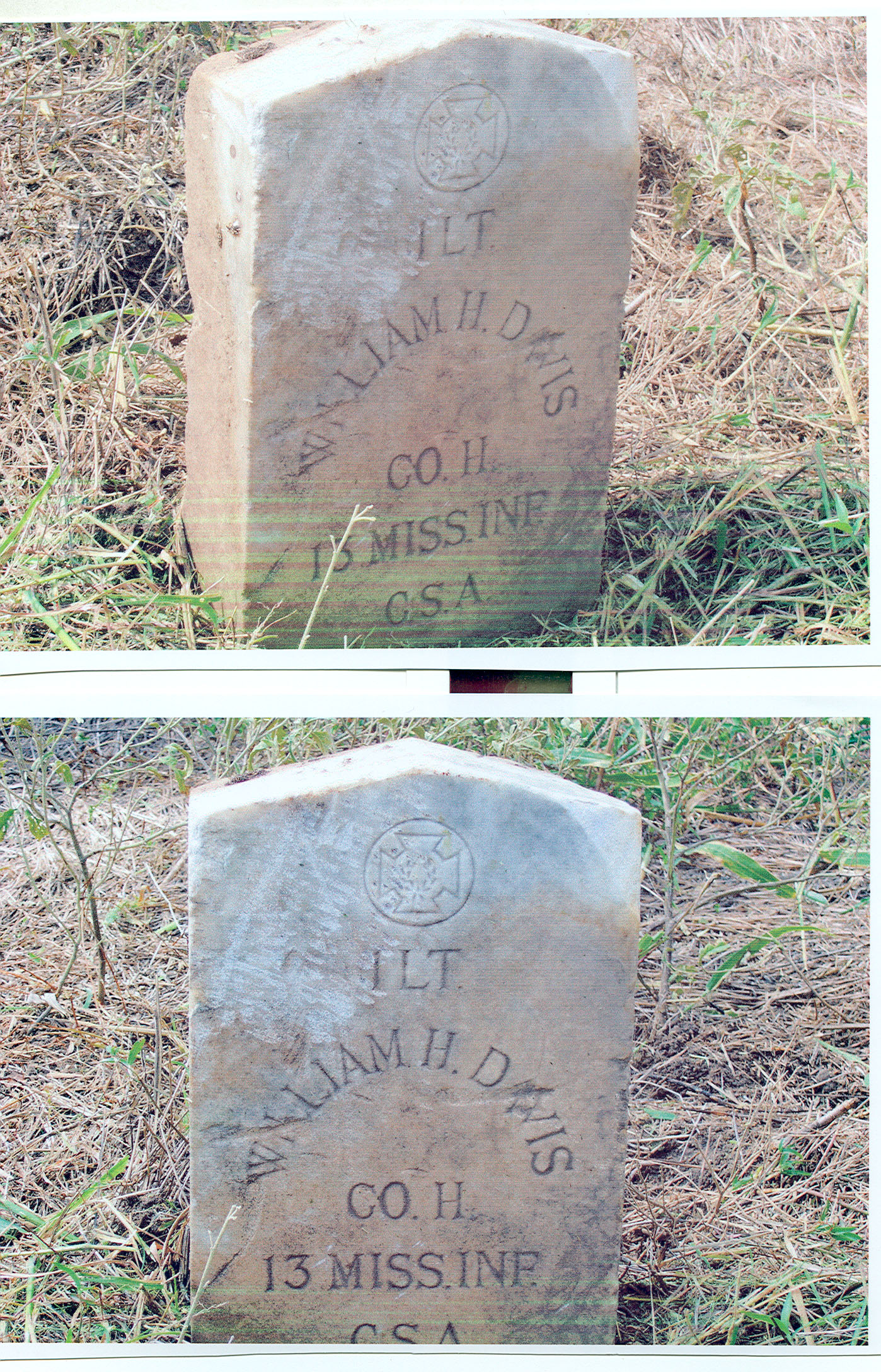
Jess McLean of Dallas, author of the only compendium of the troops of the 13th Mississippi Infantry Regiment (of whose unit I am finishing the first regimental history), is trying to preserve this old grave in Lyons, southeastwest of  College Station.

The lieutenant named on the tombstone, William H. Davis, began the war as a private in the 13th’s Spartan Band (later Company H) and had the doubtful distinction of being in command of the remnant of the regiment that surrendered at Appomattox in 1865.

Somehow 1LT Davis, who was from Chickasaw County, Mississippi, wound up buried on private property in Lyons, Texas. Jess still is trying to figure how that happened as well as trying to interest the SCV in protecting the grave with a fence. It needs one because the new landowner’s seasonal mowing has periodically scarred the stone and knocked it down

The Texas Unionists

Edmund J. Davis was one of the about 2,000 Texans who fought in the Union army during the Civil War. He survived to become the last Reconstruction governor.

But there were many more who offered their dissent at home and some were punished for it, including in the still-celebrated Nueces Massacre of German Unionists and the little-remembered Great Hanging in Gainesville of suspected Anglo Unionists, possibly the largest example of vigilante violence in American history.

At First Light

This new painting of the 9th Georgia Artillery Battalion opening fire on Fort Sanders on Nov. 29, 1863, is one of the few that’s ever been done on the battle that is the subject of my historical novel Knoxville 1863.

Artist Ken Smith of Pulaski, Virginia, is offering a print for sale here. The novel recently made its 100th sale, in paper and as a Kindle ebook, both in the US and the UK. A pittance, indeed, but not bad considering its trifling promotion.

Climate Czar of Mars

The usual shrill babble and punchy trailer clips are flogging John Carter, Disney’s remake of Edgar Rice Burrough’s 1917 novel Princess of Mars, but it looks like a kiddie combo of Hercules and Avatar.

The bad guys burn coal, you see, and are damaging the Martian atmosphere. Uh oh. John Carter is a Confederate soldier mysteriously transported to Mars. There he engages in a lot of sword play, some love scenes steamy enough for 14-year-old boys, and I’ll bet more than a few ecology speeches about sustainability and global warming. Face palm.

This just in from the Civil War…

The (apparently) world’s first combat submarine, which few alive today have ever seen. Now you can be one of them. You’d never have gotten me in that thing. I’m the descendant of  infantrymen. But I can’t help but admire the sailors who volunteered for the H.L. Hunley—and perished.