Category Archives: Library

Ersatz dignity at the Alamo

Took visiting Israeli friends to San Antonio on Friday to see the Alamo and was surprised to find the city has removed the parking meters on the side streets since the last time I was there. Now you’re at the mercy of the high-price lots—five to ten bucks to park.

Much as I like the place—a tiny island of history almost smothered by modern urban commercialism—I came away irritated. Years ago, they kept the trinket-sales in the back of the chapel. Now that they’ve been removed to a special gift-shop building, ersatz dignity is the rule.

One of the red-vest docents asked me to remove my hat in the chapel. Without the trinket cases, see, it’s a shrine to the dead heroes. No such thing in the adjacent Long Barracks museum, however, where far more of the defenders actually died than did in the chapel.
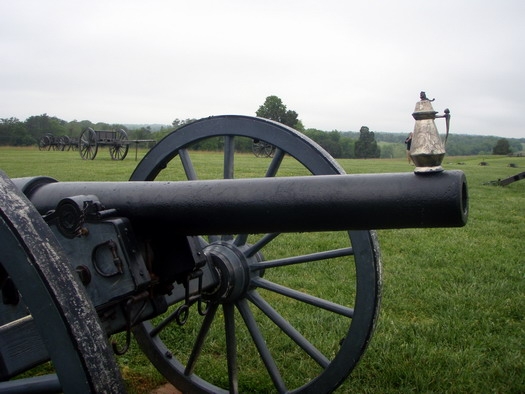
Syrup cannon

Jo Anzalone, who is descended from a 13th Mississippi Infantry Regiment soldier, took a trip not long ago retracing the unit’s wartime movements.

She carried with her an antique silver syrup pitcher belonging to her Civil War ancestor, Private Jonathan James McDaniel, and posed it at different sites.

Here, the pitcher sits on the business end of a 20-pounder Parrott gun, a rifled cannon used mainly by the Union,  near the Henry House on the Manassas Battlefield in Virginia.

Jo has written a novel about McDaniel, available for free reading here. My own blog saga of the 13th Regiment continues into late July, 1863, here.

Texan first to fly?

Or only the first to crash? Jacob Friedrich Brodbeck may have made the first flight in a heavier-than-air craft, on Sept. 20, 1865–almost forty years before the Wright brothers–in a field in the Hill Country about three miles east of Luckenbach.

Tethered gas balloons had been used for military recon in the Civil War, but Brodbeck’s spring-wound engine was something new, supposedly (accounts vary) propelling him for 100 feet, just twelve feet above the ground, until the spring unwound and, oops, the crash ensued. Or not, depending who you believe.

The photo (owned by the Daughters of the Republic of Texas Library at the Alamo) suggests Brodbeck’s bird might have been a biplane, of a sort.

Osama’s Memorial Pit

Osama is gone, but he’s certainly not forgotten. He’s remembered every day in New York City (if he couldn’t make it there, he couldn’t make it anywhere) in the seven-story hole in the ground where the World Trade Center used to be.

Presided over, presumably, by the National Association of Grief Counselors, as James Lileks put it in Mark Steyn’s unsettling new book After America: Get Ready for Armageddon:

“9/11 was something America’s enemies did to us. The hole in the ground a decade later is something we did to ourselves…a gaping, multi-story, multi-billion-dollar pit, profound and eloquent in its nullity.”

With its waterfall and stone recitation of the names of the dead, the pit has become a site of presidential pilgrimage each anniversary of the destruction. Not to mention the Islamic mosque soon to rise nearby. As such it’s a tribute to Osama Bin Laden and the jihadists of al-Queda.

It’s also a monument, as Steyn puts it, to our growing can’t-do spirit, the attitude that has US headed right where Osama predicted: the dust bin of history. Hard to argue with that.

Batman at the bema

“Back in the 1930′s, it made some sense for Bruce Wayne, scion of one of Gotham’s finest families, to be a WASP. But look around NYC and see whose names are on the hospital, university and theater buildings. Don’t get us wrong…Batman has to be named Bruce Wayne. But who’s to say he wasn’t named after his great-grandfather, Baruch Wien?”

Humor by Heeb.

Luttwak talks Bin Laden and Israel

I’ve often wondered why it was necessary to kill Osama. American military strategist Edward Luttwak, in a fascinating new interview in Tablet Magazine, has an excellent answer:

“They killed him because of the fact that if we captured Bin Laden, every Jihadist in the world would have been duty-bound to kidnap any American citizen anywhere and exchange him for Bin Laden.”

Luttwak also thinks constant conflict with the Arabs actually is good for Israel because it has produced an internal cohesion that might not otherwise exist. Read the whole interview here.

Nightmare

This is one strange piece of music, first composed in 1936. Compelling, however, and also strange to think that a Swing-era big-band leader chose this for his theme song. Downloadable for free at this link, or just play it there until you tire of it. If you do. I didn’t so I bought it at Amazon for 99 cents.

Clarinetist Artie Shaw was the band leader, a nice Jewish boy who had a few other quirks. Which I am discovering in this exceptional biography. Married eight times. Estranged from two kids—though one of them made an effort to forgive Artie in his old age. Not a model in the parenting or husband department, obviously, but a helluva musician who lived to age 94, and was gutsy to boot.

Shaw, already famous and wealthy, did WW2 as a Navy chief leading a Swing band for the forces at front-line places like Guadalcanal where he was once bracketed by dropped Japanese bombs and went deaf in one ear. The word picture I can’t forget is from 1943: his band playing Nightmare as they descended on an aircraft elevator to their below decks audience on the aircraft carrier Saratoga.