Category Archives: Library

The coming Ice Age

Hot enough for you? It’s edging back up to 100 degrees F at the rancho this morning, where it’s topped out daily for more than a week now. And, frankly, when the sunspots started up again last year, I figured, well, predictions of an ice age were more than a bit premature.

So imagine my surprise at today’s announcement at the AAS: “The American Astronomical Society meeting in Los Cruces, NM has just made a major announcement on the state of the sun. Sunspots may be on the way out and an extended solar minimum may be on the horizon.”

If so, the current heat wave will soon be relegated to nostalgia and global warming a desirable phenom. Indeed, perhaps the only thing to save us from widespread crop failures due, not to excessive heat, but frigid, icy temperatures worldwide.

UPDATE:  If you want an idea of what it might be like, try Fallen Angels, with its predictions of blizzards in Missouri in September and returning glaciers (300-feet high at their leading edge) sliding ever-farther south.

Mousing the Internet

If you’re tired of the phrase “surfing the Internet” (since water and electronics are a poor mix) try Sci-Fi author Michael Flynn’s locution (from his novel In The Country of the Blind): “mousing the Internet.” Makes a lot more sense. Since you already have a mouse, right?

Eifelheim

Michael Flynn’s 2006 Sci Fi novel Eifelheim, is a winner.

It’s a story that plays against type from the beginning and never lets go. Very imaginative and well done, particularly the dialogue between the Medieval European villagers and the grasshoppers from the stars.

I kept hoping the latter would save the former but finally realized they couldn’t. They weren’t much better equipped than their hosts. It’s a sad story but not a hopeless one and that makes it especially memorable and appealing.

The Sherman Tank

Of the scores of old and new battle tanks on open-air display at the Israeli Armored Corps museum at Latrun, west of Jerusalem, only the M-4 Sherman gets a tall pedestal and flood-lamps to spotlight it by night.

The modified M-4 was Israel’s mainstay in the wars of 1948 and 1956 and was still in use in the wars of 1967 and 1973. So it gets official reverence, anyhow, even if some of its crews probably hated it as much or more than some American veterans of World War II who considered it outclassed by German armor.

But the tank that once graced the lawns of most National Guard armories across the U.S. (now replaced, for the most part, by M-48 Pattons) still has its defenders. Some of them recently unloaded on Death Traps, a new World War II memoir about the problems of maintaining the under-armored and under-gunned beasts. They were, of course, appropriately named for an American Civil War general who was also quite controversial.

Gamla

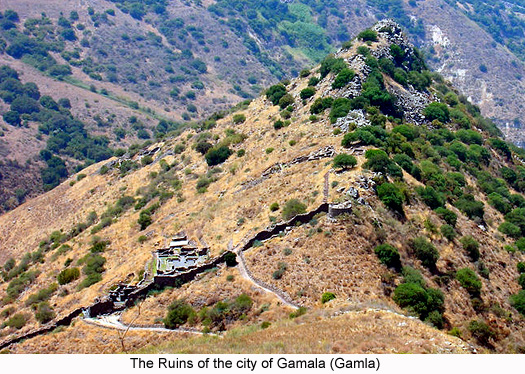
One of my favorite spots in Israel is the national park at Gamla. Most of my “establishing” photos came out blurry, so I’ll use this one via Absolute Astronomy.

Gamla dates to 81 BCE and was the capital of the Jewish Golan Heights for about 150 years, until it fell to the Romans in 67 CE, three years before they destroyed Jerusalem. To some sensibilities, Gamla was liberated almost exactly 1,900 years later, in the 1967 war—which was started, as usual for modern Israel, by the Arabs. Archeologists soon discovered that much remained at Gamla, untouched by all but time.

More 175th Texas Revolution

Contrary to debunkers belief, the Alamo defenders were not strictly Anglos. These reenactors portray some of the Alamo’s Tejano volunteers in the 1836 battle.

A snap by San Antonio author and retired Air Force veteran Celia Hayes who notes they are a “titch older” than the men they portray. And porkier, I might add. Don’t the young (and fit) care about these things?

Texas at 175


Texian volunteer at the Alamo, a reenactor on this 175th anniversary of the Texas Revolution.

At least his physique is plausible.

Too many reenactors these days, particularly Civil War ones, are aging fatsos with white hair. Reflecting our overfed, indulgent culture, rather than the more austere 19th century.

Photo by San Antonio author Celia Hayes whose good gallery of such snaps is here.