Tag Archives: spaceweather.com

Look, up in the sky

Per009_zhr_strip.jpg

As usual, astronomers are predicting more Perseid meteors than usual. Unusually, for a change, they may be right. According to Spaceweather.com: "A filament of…dust [from Comet Swift-Tuttle] has drifted across Earth’s path and when Earth passes through it, sometime between 0800 and 0900 UT (11 – 12 am CDT) on August 12th, the Perseid meteor rate could surge to twice its normal value…The [above] profile is based on…debris stream models…"

A useful reminder (for those of us who live under the urban halo) that we live on a planet, which is rotating about a thousand miles an hour (at the equator) while trucking five hundred forty million miles around Sol at about sixty-seven thousand miles an hour. And don’t forget that Sol is moving around the center of the Milky Way galaxy, while the galaxy itself is just one of many, widely-separated "islands" drifting through the black of intergalactic space.

Funny, I don’t notice any unusual motion. Do you?

Lunacy

See the moon turn red tonight, maybe even a bit turquoise. And, if you’re near Hawaii, you may get to see the Navy shoot down a satellite at the same time. Eclipse Central is at space weather dot com.

UPDATE: Austin is famous for unviewable sky events due to cloud cover, and tonight, alas, is no exception. Fortunately there are Web cam views at the second link, if clouds are in your way, as well. 

That Peruvian meteorite

A closer look, in PDF, via spaceweather.com. Where did all the water come from? The impact crater is below the water table. As for the mystery illnesses? Arsenic-tainted ground water.

Green comet

Lower Colorado River Authority meteorologist Bob Rose notes this at spaceweather.com:

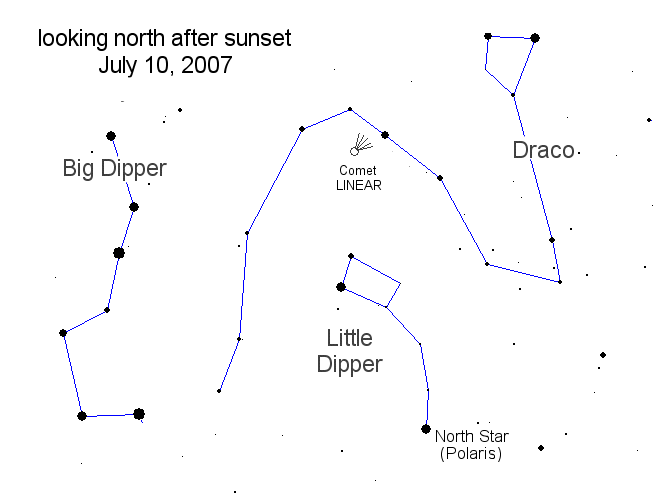
"Grab your binoculars. Pretty green Comet Linear VZ13 is gliding through the constellation Draco this week. It’s too dim for the unaided eye, [but some say a 7X35 binocular will do just fine]. To find [VZ13] go outside after sunset and face north; the comet lies just a few star hops from Polaris."

It helps to be high enough to see the horizon. A finder map here which is dated the 10th but should be helpful through tomorrow night. 

Luminous, blue-white tendrils

An outbreak of neon-blue, noctilucent clouds over Europe’s and the U.S.’s northern tier. Also visible from the space station.

Saturn views

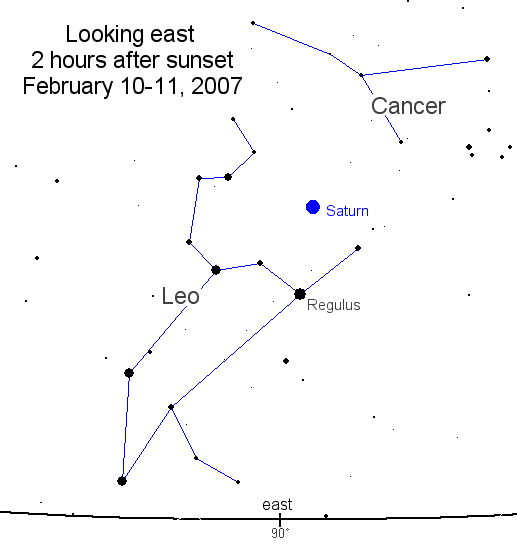
Good views of Saturn possible this weekend with a home telescope, two hours after sunset in the Northern Hemisphere, looking east here until it’s overhead by midnight. Should have a good view of the rings as they are tilting towards us.

From SpaceWeather.com: "Saturn is at its closest to Earth: 762 million miles. It thus looks bigger and brighter both to the naked eye [resembling a bright, yellow star] and through a telescope than it will at any other time in 2007."

Catch a falling star

The Geminid meteor shower could be a winner this year, for the Northern Hemisphere, from Wednesday evening into the twilight before dawn on Thursday. If the waxing moon doesn’t get in the way. To avoid that, face west with the moon at your back.

"…people in dark, rural areas could see one or two meteors every minute," for what could be the best meteor shower of 2006, in speedy, bright streaks of yellow across the star-spangled black.

Via Spaceweather, Sky & Telescope, and Space.com, the most pessimistic of the trio.