
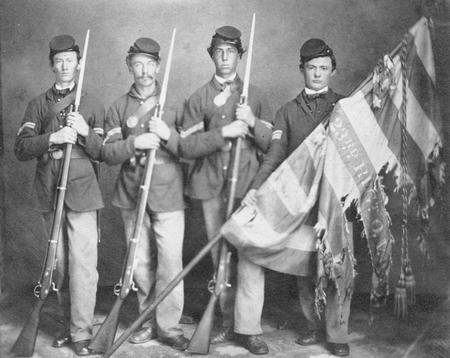
 I’ve always liked this old shot of some of the 23rd Ohio. Not that I fall for the notion that they were freeing the slaves. But they certainly held the country together and bless them for it.

Meta
Gun Owners of America

-
Recent Posts
- The colonizers May 12, 2024
- Degenerate animals December 30, 2023
- The War of Seven Fronts December 27, 2023
- Just close the damn border December 26, 2023
- Here? Of course. November 16, 2023
- Weird chemical smell November 12, 2023
- Israel’s 15 ceasefires November 6, 2023
- “Arise and take our stand for freedom as in the olden time.” -Winston Churchill
Archives
Blogroll
- Abolish the IRS
- Advice Goddess
- Aish
- Althouse
- American Free Press
- American Glob
- American Greatness
- Arutz Sheva
- Axios
- Babylon Bee
- Bad Blue Uncensored News
- Bearing Arms
- Ben Goldstein
- Blog of Death
- Breitbart News Syndicate
- Buddha at the Gas Pump
- CAMERA
- Canary Mission
- Chicks on The Right
- Clarion Project
- Colossus of Rhodey
- Commentary
- Concealed Nation
- Conservapedia
- Curmudgeonly Skeptical
- Daily Caller
- Daily Signal
- Diana West
- Diogenes Middle Finger
- Donald J. Trump
- Duffel Blog
- Dustbury (In Memoriam)
- Earl of Taint
- Elder of Ziyon
- Eschaton
- Eternea
- Everlasting Phelps
- Fox News
- Gab
- Gates of Vienna
- Gateway Pundit
- Gay Patriot (In Memoriam)
- Globes
- Heartland Institute
- Heeb
- Heritage Foundation
- Hook'Em
- Human Events
- Ice Age Now
- IDF Spokesperson
- Instapundit
- Israel Matsav
- Israel Video Network
- Jazz Advice
- Jewish Press
- Jewniverse
- John Wilkes Club
- Join The NRA
- Jordan Is Palestine
- Kotel Cam
- Lake Travis Webcam
- Legal Insurrection
- Lucky Gunner
- MACV Teams
- Maggie's Farm
- Me on Facebook
- Me on Twitter
- Meh
- Melanie Phillips
- Meteorological Musings
- Mind-Energy
- Miriam's Ideas
- Mostly Cajun
- Mouth of The Brazos
- My Old RV (In Memorium)
- NetRightDaily
- New Geography
- NewsBusters
- No Tricks Zone
- One America News Network
- Palestinian Media Watch
- Pamela Geller
- Pat Condell
- People's Cube
- Phase Line Birnam Wood
- PJMedia
- Planck's Constant
- Political Clown Parade
- Political Pistachio
- Power Line
- PreOccupied Territory
- Quod Verum
- Real Clear Politics
- Real Science
- Red's Guns
- Ricochet
- Rule of Reason
- Sandmonkey
- Save The Royal Navy
- Seablogger (In Memoriam)
- Self Reliance Central
- Shooting Illustrated
- Simply Jews
- Skeptiko
- Slashdot
- Small Dead Animals
- Sooper Mexican
- Steyn Online
- Stiltons Place
- Streamliner Memories
- Streetwise Professor
- Sultan Knish
- Tablet Magazine
- TechDirt
- Texans United
- Texas Insider
- Texas Insider
- Texas Policy
- The Blaze
- The Blogesss
- The Fat Guy (In Memoriam)
- The Federalist
- The Grand Scheme
- The Imaginative Conservative
- The Israel Project
- The Other McCain
- The Passing Parade
- The Rebbe
- Times of Israel
- Trigger Warning
- Twitchy
- UN Watch
- Urgent Agenda
- Violin Lab
- Vocabula Review
- Volokh Conspiracy
- Washington Examiner
- Waterloo Trio
- Watts Up With That
- We Are For Israel
- Weasel Zippers
- Weather Bell Analytics
- Weekly Standard
- Western Journalism
- Whatfinger
- Yoani Sanchez
- Your Brain On Porn
- Z Man
- Zero Hedge
Support Wikipedia

-








 THE TEXAS SCRIBBLER
That is a good photo Dick; thanks for posting it. The 23rd Ohio was noted for having two future Presidents among their members. Rutherford B. Hayes, their commander for most of the War and William McKinley who enlisted at age 18 and rose from Private to Bevet Major. Back in the 1960s, the historian T. Harry Williams wrote, “Hayes of the 23rd: The Civil War volunteer officer”, a first rate history of Hayes’ wartime career and the regiment he led. According to Amazon. com it is currently available in paperback.
I agree that since the 23rd Ohio came from south-west Ohio, that it is not likely that the soldiers were motivated by a desire to free the slaves as much as they were to preserve the Union and keep North America from becoming divided into hostile countries as Europe was. In northern Ohio, settled originally by New Englanders moving west, there was a strong anti-slavery movement before the War and support for ending slavery as a Union war aim. Oberlin College, west of Cleveland was the first college in the US to admit blacks. One of Oberlin’s professors led Ohio’s first black regiment, the 5th US Colored Troops during the Siege of Petersburg in 1864, where several soldiers of the 5th would be among the first blacks to receive the Medal of Honor.
Thanks for the info, David. I didn’t know about Hayes and McKinley being in the 23rd. No wonder the photo has such currency in the ACW collections. I run into it all the time. Of course the collections are almost entirely Union. A few rare ones of live Rebel prisoners and many more of Rebel dead, but that’s about all.
It’s funny, funny strange, that is, that the abolition movement was never popular enough in the North to include integration of the freed slaves. Congress only insisted the South include it during Reconstruction. They never turned their attention to the Northern states. You might be interested in this good site’s history of Northern slavery and New England, etc. discrimination against the Freedmen:
http://www.slavenorth.com/exclusion.htm
Thanks Dick, that looks like an interesting site. The descrimination and outright prohibitions against blacks throughtout the North, before, during and even after the Civil War was pretty bad. It was rather hypocritical of the post-war Republican Congress to insisit southern whites had to extend the vote equally to blacks in order for their states to be re-admitted into the Union;, when in the North only Massachusetts, Rhode Island, New Hampshire, Vermont and Maine had equal voting rights for both white men and black men. New York allowed for black sufferage, but only for those who had a certain amount of property while no such requirement was made for whites. In 1867 & 68, a number of northern states including my home state of Ohio voted against allowing blacks to vote. Only the states of Minnesota and Iowa voted to allow the few blacks in their state the right to vote.
As the slavenorth.com site makes clear, (complete with footnotes) there was the law in the Northern states and then there was the reality, and they were often different.