Category Archives: Library

When reporters play dressup

I enjoyed James O’Keefe’s undercover reports on ACORN’s willingness (in its offices coast to coast) to assist a pimp and his chippy in acquiring a business location. But, despite the 60 Minutes example, undercover reporting can quickly lead to problems that undermine the pursuit of truth.

Thus, despite big media’s retractions of late on details of O’Keefe’s investigation of a Louisiana senator, the fact remains that he dressed up as a telephone repairman. As Ed Morrisey says, he apparently didn’t need to do that if he wasn’t planning to break the law. It logically led to suspicion that was what he was about and his arrest.

Heh

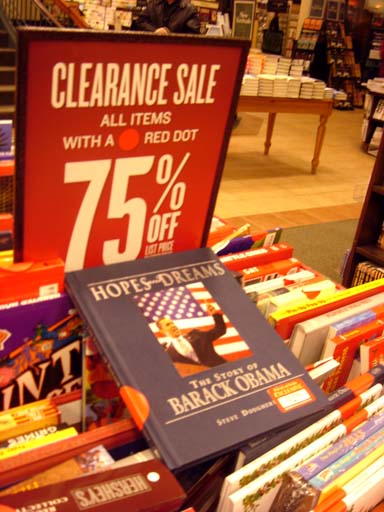
hope change 75 perecent off

Let the ridicule begin. Hope-n-change is declining in value. No surprise.

Via Instapundit.

UPDATE:  VDH scores some ridicule hits with his “Obamarang” essay:

“Obama assures on eight occasions he will televise all health-care deliberations on C-SPAN. This [was] clear proof that nothing [would] be televised [and, indeed] debate occurr[ed] behind closed doors, punctuated by votes purchased through $300 million bribes and state exemptions from federal statutes.”

Cauldron

I enjoyed this apparent finale to the Hutch Hutchins series of space operas Jack McDevitt began years ago with Engines of God. As usual, I don’t quite understand the put downs of a good number of the Amazon reviewers. The book may, indeed, have filched a Star Trek plot device. I wouldn’t know. I couldn’t remember all the ST shows if I tried. They’re too boring.

McDevitt repeats his themes, of course, but he is rarely boring and he certainly isn’t here. There was one glaring error which amazed me. In the first paragraph of the epilogue the Preston superluminal returns to Earth space. Two pages previous it was destroyed near the galactic core. Fortunately its lovable AI Phyllis was saved. Pitiful editing that. Nevertheless, it was a fun read and a good place to end the series. Hutch deserves her porch rocker even if she wouldn’t want the rest of the human race to lollygag on its porch without having first gone forth as boldly as she did.

Diddling with Paint Shop Pro X

I bought this software because it was about a tenth the price of Adobe’s Photoshop and, supposedly, does most of the same things. Indeed, it’s been dandy for creating DIY book covers for POD efforts, though it takes patience and careful following of the User Guide.

I’m just about ready to produce my Civil War historical novel. I rode the query-letter hamster wheel for seven months without getting a single look at the manuscript. I’m told one should plan to wait two years but, at my age, well… Besides, my usually-tough in-house editor loved it and so I’m moving on.

(Uh, I checked the dictionary too late. I chose an unfortunate verb for the headline. Should have been fiddling. Well, who knows? It may turn into another Roberta Vasquez moment.)

The Last Stand of the Tin Can Sailors

It’s been a while since I finished this good one, and I’m not sure why I didn’t write a review at the time. The mental pictures of little destroyer escorts plunging through big seas to take on Japanese cruisers in order to protect American escort carriers linger yet. It was in the last days of the “gun ship” era.

The scenes must have been working on me subconsciously when I recently ordered a similar book. But I really got interested as a child in the 1950s. As the son of an Air Force veteran of the war whose chums were mostly sons of Army veterans, naturally I developed an interest in the Navy.

I made numerous plastic models of the warships, particularly the destroyer escorts. Kids today have much less access to such things, partly because not enough of them are interested to keep the industry afloat (so to speak), in addition to copyright pressures from such as the aerospace manufacturers. Pity. But I remember my dad who came up in the wooden model era thought the plastic ones were too easy.

The real Crockett: Davy or David? Both

Excerpt from the Introduction to

David Crockett in Congress:  The Rise and Fall of the Poor Man’s Friend

(Bright Sky Press, 11/1/09), by James Boylston & Allen Wiener, hardcover, 336 pages with 16 color photographs, $29.95.

In the mythology of America, the legend of Davy Crockett looms large. As a pioneer, Indian fighter, congressman, and martyr of the Alamo, Crockett’s remarkable life has been the subject of biographies, novels, comic books, plays, songs, movies, and television shows. The image of the coonskin-capped, buckskin-clad hero swinging his rifle like a Louisville Slugger atop the Alamo is iconic; to most folks, Davy Crockett really is the King of the Wild Frontier.

While Crockett certainly was a pioneer and hardscrabble farmer, a soldier in the Creek War, and a hero who gave his life in the fight for Texas independence, he was also an inveterate entrepreneur and a career politician with a talent for hardball campaigning. More Will Rogers than Daniel Boone, more broadcloth than buckskin, David Crockett began his political career as a justice of the peace and magistrate, and served two terms in the Tennessee State Legislature before being elected to the U.S House of Representatives for three terms. Always popular in his district, Crockett nevertheless was a hard-fighting campaigner, as he faced the formidable political machine of Andrew Jackson in virtually every engagement.

Crockett was a masterful campaigner among his frontier neighbors, an amusing jokester, storyteller and speaker. His jokes and stump speeches helped him win elections, but once in office, he proved himself an astute politician and parliamentarian. Crockett understood the issues under discussion and how his colleagues stood on them; thus, he was able to maneuver effectively among them, sometimes gaining victories for himself.

Crockett’s most important political objective was to secure for his poorer constituents legal title to the land they had worked and improved.  He never achieved that goal, but his exhaustive efforts to do so illustrate his devotion to the people who elected him and his insistence on serving them rather than a political party or its leaders. Throughout his career he remained, first and foremost, an advocate for the poor, whom he viewed as constantly pushed aside or ignored by wealthier, more influential interests.

He resisted affiliating himself too closely with any faction and believed that party loyalty should never be placed above principle or duty to his constituents. Crockett came to view strict party discipline as a threat to democracy that distanced elected officials from those they represented.

The search for the real Crockett, often lost behind a haze of movie and other fictional images, reveals an independent spirit who rebelled against injustice and government cronyism.  He railed against partisan politics, and refused to toe the party line, believing he need only answer to his constituents.  He was an egalitarian who bristled at the idea of class privilege and held the belief that people had a right to land they had worked and fed with the sweat of their brow.   His roots endeared him to his neighbors and won him elections, while alienating many of his Washington peers.  As his motto suggests, when he was sure he was right, he really did go ahead.

David Crockett In Congress Site

Buy a copy here

Also see author James Boylston’s Alamo Studies Forum

Godspeed

Wonderful tale, this hard scifi novel of the hard times of the planet Erin, whose Irish inhabitants came from a monocultural, multigeneration starship trek. I stayed up late finishing it. Did find it amusing that the back cover synopsis compared it to Robert Louis Stevenson’s Kidnapped, when it’s obviously mimicking Treasure Island in most ways. Captain Shaker is a very credible Long John Silver and Jay Hara a Jack Hawkins in hard vacuum. It’s a great pity that physicist-author Charles Sheffield has passed on. He was a very entertaining story teller.