Category Archives: Music

Tearing down the melody

“You don’t have to play every note,” mandolin player Earl Hunt told me when I said I was still learning to play hoedowns (reels) and jigs as fast as the melody fiddlers do in our pickup contra dance band.

How do you decide which ones to leave out, I wondered aloud, and he smiled and replied, “Keep practicing.”

It’s really rather simple, my fiddle teacher told me. It’s called “tearing down the melody,” eliminating the notes that are there just for show, “the fiddle fireworks,” he called them. The notes which don’t contribute to the melody. So long as they’re not crucial to the rhythm, which is foremost.

Meanwhile, I’m also struggling to learn to play (scales now, tunes later) with the Georgia and Nashville shuffle bowing patterns. There’s always something new to learn.
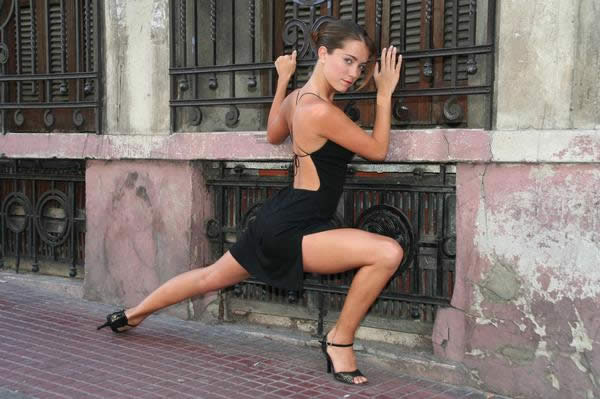
Rule 5: Tango dancer

My versatile fiddle teacher, James Anderson, has a new CD out by his Austin tango band, on which he was a composer and arranger as well as a performer. I’m sure he’d love to have this gal’s talents, even if I can’t find out her name.

Hammered dulcimer

Something new at LOCO’s weekly performance the other night: a hammered dulcimer. That sucker has 48 strings. Imagine the time consumed in tuning it. Comparable to tuning a piano.

The guy who brought it discovered it was out of tune (probably the heightened humidity from the rain that day) and didn’t seem to want to waste time tuning it, so played his fiddle instead. I think he played it once, though. It was hard to be sure, as I was sitting between an amplified fiddle and an amplified mandolin, and could hardly hear my own efforts at fiddle harmony.

I’m getting better at recognizing keys and playing chord voicings contributed by my teacher. Instead of trying to keep up on the sheet music, by counting the beats, I finally figured out what the chords look like on the guitar and now I watch those players, instead. Still a challenge to keep up, though, and I sometimes revert to long, slow bowings of the pentatonic scale in whatever the key is because it fits with every chord.

The Spock Hand Frame

Helping me figure out how to play old favorite Shalom Aleichem in F minor (four flats) the other day, my fiddle teacher said the best way to approach so many flats in one piece is to use a hand frame to feel where the notes should go on the fingerboard. Such tricks are necessary because fiddles don’t have frets like guitars do.

Use the Spock Hand Frame, he said, smiling and holding up his left hand in the old Star Trek “live long and prosper” gesture—you know, with the index and middle fingers close and the ring and pinkie fingers close with a V-shaped gap in between the middle and ring fingers.

The irony of this nice Christian boy’s unknowing choice of words is that Shalom Aleichem (peace unto you) is sung by observant Ashkenazi Jews on Sabbath eve. And Leonard Nimoy, the nice Jewish boy who played the pompous Vulcan Mr. Spock in the series, knowingly took the hand frame (though he didn’t call it that) from the hand sign of the Jewish Priestly Blessing, which originated in Israel (rather than on Vulcan) a few thousand years ago.

Learning stand-up bass

Another fine evening with the Local On-Call Orchestra last night playing Old Time for contra dancers. Five fiddles (two melody, our chord viola, and me and another beginner on harmony), two mandolins, a banjo, a guitar and a stand-up bass (also called bull fiddle).

“Well, I won’t have any doubt about the rhythm,” I told the bass player who was standing beside my chair. He smiled. Said he was six weeks into learning the instrument. ‘Course he also reads music and plays piano and electric bass guitar. So why the bull fiddle, I asked.

Said he’d always been interested in it and then a friend wrote a song in which one line went “Ninety percent of playing the bass is owning one.” So he bought one and started playing it.

In which I join the LOCO

Last night I officially (if there is such a thing) joined Austin’s Local On-Call Orchestra, a pickup group of fiddlers sometimes joined by a banjo, mandolin, guitar or even a double bass.

LOCO plays every Wednesday at the Hancock Rec Center on East 41st Street for fifty or so impromptu contra dancers (a traditional line dance that’s sort of square dancing without the square) who rely on the rhythm of old timey tunes like Red Wing, Whiskey Before Breakfast, and Liberty.

Some of last night’s pickup fiddlers were much better than me and consequently played a lot faster (around 112 beats per minute) than I can (more like 60 bpm), so I followed my teacher’s instructions to just play chords, “chunk” the rhythm on the key string (most everything was played in G, D, or A), even improvised a little. I was able to play the two waltzes at the end of the evening.

The dancers rely on the rhythm. They applauded the players at the end of a tune (looped repeatedly for about ten minutes) but otherwise ignored us. So there was no audience pressure as such. I doubt they heard the notes at all, though some of the fiddle players were quite good and helped us beginners sound not-too-shabby. It was a lot of fun. I will go back next week.

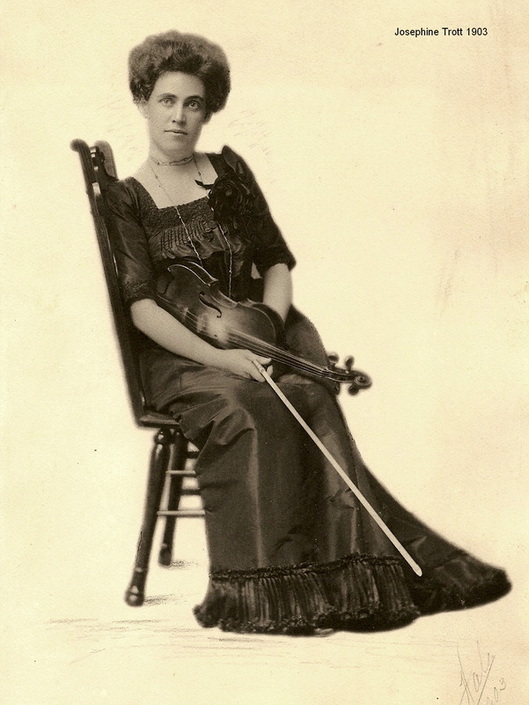
Rule 5: Josephine Trott

A different Rule 5, perhaps, but this was fashion in 1903, and Ms. Trott was to become famous as a composer of a book of exercises for fiddlers called Melodious Double-Stops. It makes learning a difficult technique at least, well, melodious.