Category Archives: Science/Engineering

Lovin’ my Kindle

For various reasons, the Kindle is a lot of fun. Free books is part of it. Not only the classics but the freebies paying publishers sometimes give out to test the waters for the product they will soon put a price tag on.

Such as this popular old Indie scifi tale  soon to be brought back as an Amazon Encore in paper. Meanwhile, the author is offering it free in various ebook formats (including the Kindle) at his website. Cool. You never see this in paper. Nobody could afford to do it.

I like my Kindle 2

I’m only surprised at how quickly the battery runs down if you use it on and off all day long. I read a novel, Enders Game, over the weekend, is how I found out. It’s cool being able to surf the text Web for free and email personal Word and/or PDF files to the device for later use.

So far I just like to read. Currently that’s The PayPal Wars: Battles With Ebay, The Media, The Mafia, and The Rest of Planet Earth, whose lazy author uses an incredible number of cliches but otherwise produced an entertaining tale of a Web startup’s vicissitudes. I have found this good site filled with Kindle advice, more than I’m ever likely to follow, but it’s nice to know it’s there.

The Devil’s Eye

Literary agent Nathan Bransford is always coming up with something interesting to post. The other day it was one that sounds old but was new to me: If you could live in the world of one novel, which would you choose? I’d choose the space opera world of Alex Benedict and Chase Kolpath, as created by SciFi author Jack McDevitt. Actually there are four novels. Any one of them would do fine.

I’ve read all four. Began with Polaris and then its wonderful sequel Seeker, only to discover that I missed the first one A Talent for War. So I read and enjoyed it, too, before finishing the fourth, The Devil’s Eye. Now it seems there will be a fifth one, Echo, this fall. Their world, in which there is so little crime the police are happy to get a new case, seems ideal. Their planet, Rimway, is in a galaxy far, far away, in the arm of Orion–my favorite constellation.

Not everyone gets to travel by starship like Alex and Chase do, but the opportunity is there. Just flitting about in gravity-free skimmers would be pleasant enough. (Although I do wish they would realize that someone is always tampering with theirs and plan accordingly.) Also having one’s personal AI, linked in to the galaxy-wide net to help research anything by voice or avatar. But what I like most is the way McDevitt writes. Conversationally. I flow along with the story, happily ensconced in the moment,  not entirely concerned about where events are going. Just enjoying the ride and hoping it never ends.

More 107-inch telescope

HarlanTelescope1

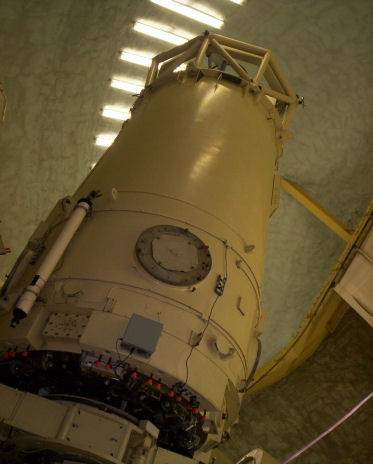
Looking more like a giant X-ray machine than a telescope, McDonald Observatory’s 107-inch reflector inside its closed dome on Mt. Locke is one of the few, if not the only, modern telescopes with bullet holes in its primary mirror. I’ve heard and read several versions of the tale. This one pretty much echoes most of them.

Harlan Smith 107-inch reflector

HarlanTelescope

Dome of the telescope at McDonald Observatory in West Texas that helped map the near side of tidally-locked Luna before the landings began in 1969.

A Canticle for Leibowitz

Powerful book, this, despite the irony that fifty years after it was first published, nothing remotely close to its apocalyptic vision of nuclear holocaust has yet occurred or even seems likely. Not even with the Iranian push for nukes.

There is another irony about this classic SciFi tale (which is only really SciFi at the end and then space opera not hard science) and that’s the lengthy and inspired Catholic discussion about how even people dying in pain should not offend G-d by taking their own lives. Then, Googling, I discover that the author, Walter Miller Jr., killed himself.

Nevertheless, his book is a wonderful read, thoughtful and challenging, from beginning to end. With plenty left to chew over (see his chin-choppers poem below) long after the last few paragraphs are done with. I love the fact that it takes place in Texas, with Texarkana, Pecos and Laredo in starring roles. Think I can see why he did not write a second one until forty years later and it never equaled the first. The lit crits must have smothered him with love. Then, being a World War II combat vet, he had PTSD guilt to deal with, also. R.I.P.

Flashforward

I enjoyed the hard-science aspects of this book, despite its unusual number of typos (proof that even mainstream publishing needs line editing) and Sawyer’s penchant for callous heroes. I was lucky in that I’d never heard of the TV series (until I read some of the other reviews at Amazon) and so was not distracted by comparing the book to it.

By callous heroes, I mean the Japanese engineer’s decision to leave her dead child in the street (to the care of strangers) so she can get back to work. It was of a piece with the hero of Calculating God who decides that his spiritual enrichment justifies leaving his children to grow up without him. It’s really just Sawyer’s hell-bent determination to move his plot at whatever cost.

But the physics-philosophy of this tale—Is the future immutable? Is free will an illusion?—is worth the effort to overlook the flaws. Even the Canadian author’s usual digs at American gun ownership and lack of socialized medicine. When authors like Sawyer reach a certain peak of fame, not only does the editing of their books decline, but they feel free to push their politics. Pity that.