Category Archives: Space

Dusty dark

For a while it seemed that nothing could stop those unstoppable Mars rovers, Opportunity and Spirit. Something finally has, and threatens to do it permanently. A huge dust storm is blocking what little sunlight Mars gets, the very ultraviolet that the rovers need to keep their juice flowing.

UPDATE By Monday, the 23rd, "…skies might be clearing a little."

That’s one small step…

No kidding. Talk about pathetic, as Instapundit says. Spend all that money, make all that effort, then go to the moon and pick up some rocks and hit a few golf balls. And never–NEVER–go again. Past pathetic. Bizarre. At least Houston got free advertising, and grew, and grew, and grew. Where was I? On patrol in Vietnam. Not, therefore, paying a whole lot of attention. I remember being only vaguely aware of it. Where were you?

mySKY

This sounds really cool, if a bit pricey at $399:

"Here’s how it works: You point it at a planet, or star, or galaxy that you want to identify, aim as best you can, and press a button. Voila–information about what you’re aiming at appears on the device’s color LCD; some more important objects even have voice recordings and video that go along with them."

Of course it would then reduce your night-vision considerably. But that’s a minor problem, I suppose. 

Green comet

Lower Colorado River Authority meteorologist Bob Rose notes this at spaceweather.com:

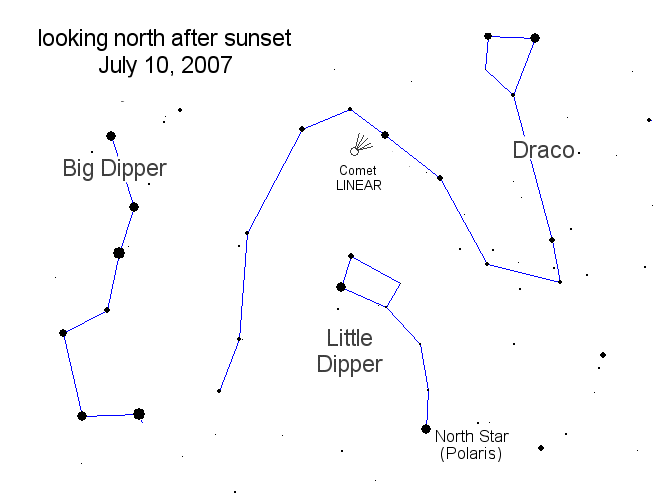
"Grab your binoculars. Pretty green Comet Linear VZ13 is gliding through the constellation Draco this week. It’s too dim for the unaided eye, [but some say a 7X35 binocular will do just fine]. To find [VZ13] go outside after sunset and face north; the comet lies just a few star hops from Polaris."

It helps to be high enough to see the horizon. A finder map here which is dated the 10th but should be helpful through tomorrow night. 

Water, water everywhere

For the second time in three months, astronomers have concluded there is water beyond the solar system. This time, researchers at Harvard and in France say they’ve found suggestions of it on an otherwise inhospitable world–a red-hot Jupiter-size gas giant–64 light years away:

"Investigations showed the planet, which orbits a star in the constellation of Vulpecula (the Fox), appeared larger at wavelength bands that corresponded to water, suggesting the substance was present in the atmosphere."

The previous one, also a hot Jupiter, is twice as far away. All this long-distance research draws conclusions only by inference, but it’s still pretty cool. 

Meteors!

Not the meteor-ological kind, but the shooting, falling star variety. Reminders you live on a planet:

"Got a calendar? Circle this date: Sunday, August 12th. Next to the circle write ‘all night‘ and ‘Meteors!‘ Attach the above to your refrigerator in plain view so you won’t miss the 2007 Perseid meteor shower."

Of course, there are plenty of caveats. You need dark skies to see much, preferably with a view of the horizon. And, for best results, you need to plan on staying up well after midnight. But they are fun. 

Today’s pretty picture

ngc2903_gabany_c720.jpg

Bright galaxy NGC 2903 looks like another inviting weekend destination, when we can figure out how to travel 20 million light years in a few hours. If ever. This one’s in the constellation Leo and just a bit smaller than our own Milky Way galaxy. /Via NASA and Cosmotography.com.