Speaking of the Civil War…
Just in time for a new movie on Richard Rowland Kirkland (the “Angel of Marye’s Heights”) comes a blogger’s debunking that, quite reasonably, thoroughly, and without rancor, burns the Angel’s wings to ashes.
I suppose it’s not surprising that Confederate Gen. J.B. Kershaw apparently created the whole thing, as the debunker suggests, in an elite Platonic effort to give the masses a few spiritual crumbs, when good feeling between the sections was being promoted fifteen years after the war.
It had been a no-quarter conflict, with murderous hatred on both sides: the Rebels for the Yankee invaders, and the Yankees for the Rebel traitors. Only Grant’s magnanimity at Appomattox, and Sherman’s with Johnston had momentarily bred a kind of reconciliation. But Lincoln’s murder brought Jefferson Davis’s capture and imprisonment at Fortress Monroe.
So here’s Kershaw, in 1880, creating a myth of the benevolent Rebel helping the dying Yankees on the killing field of Fredericksburg in 1862—when the official records show there was so much hatred that even Union hospital stewards were being targeted by Confederate sharpshooters.
All to make the losers (“We are humiliated to the dust,” as my Mississippi great-great grandmother wrote in her diary shortly after Davis’s arrest) feel better about themselves.
So what if the Angel story wasn’t true? Well.
There’s the little matters of the poem about Kirkland that Southern schoolchildren once had to memorize (instead of Lincoln’s Gettysburg Address) and, in 1965, a battlefield statue erected at Fredericksburg with the cooperation of the state of South Carolina, and now, forty-five years later, a sentimental movie.
I’ll let the debunker, Michael Schaffner, have the last, eloquent words:
“In celebrating an action that may not actually have occurred (and that Kershaw himself apparently never tried to place in the historical record), the statue [and, now, the movie] fictionalizes one man’s courage even as it overshadows that of thousands of others. In effect, the real soldiers – including Kirkland himself – have no statue. In its place stands a monument to a myth.”
UPDATE: Michael Aubrecht, writer-producer of the movie, has been following the criticism of the Kirkland legend, particularly Schaffner’s debunking. Aubrecht provided this response, including a paper by Mac Wycoff, a retired historian of the National Military Park Service. Wycoff sumarizes the evidence for the Kirkland story, concluding that there is simply too much of it to disregard the tale. I’m not sure I agree, but Wycoff makes a good case and it’s worth reading.

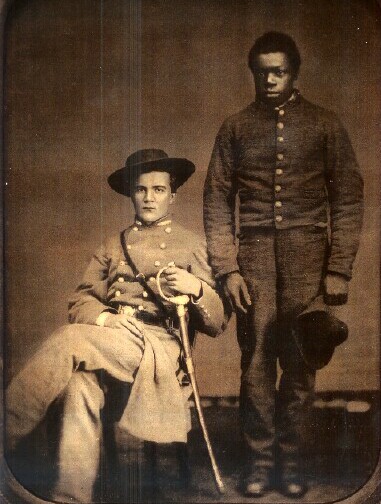 One of the saddest Civil War photos I’ve ever seen, simply because it illustrates as no other the worst of the master-slave relationship. The cocky young seated aristo, one Lt. J. Wallace Comer of the 57th Alabama Regiment. The standing slave, Burrell, lately touted as a Confederate soldier because of the private’s tunic he wears, is curiously unarmed. Not so curious, really. Their expressions say it all. Burrell is a slave, not Comer’s comrade in arms.














 THE TEXAS SCRIBBLER
