Tag Archives: Jupiter

Hot Jupiters

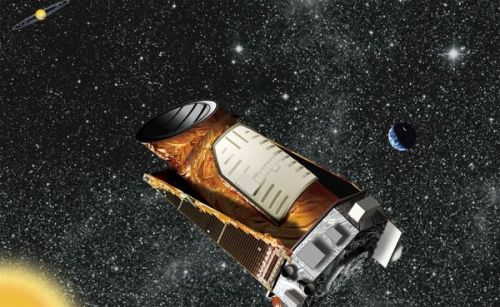
LithoArtKepler2-br

The Kepler telescope’s first five discoveries ain’t hardly habitable, which is its purpose: To find planets we might live on around distant, Sol-like stars. The five (four massing larger than Jupiter and the fifth about the size of Neptune), are high-temperature bodies. Earthlike habitables will come down the road if there are any to be found. Presumably there are, though getting to them may forever be impossible. Unless science fiction’s “hyperspace” turns out to be real and we can use it to travel many light years in a short time. Or “cold sleep” works. The tales of multi-generation spaceship passages to the stars rarely turned out well.

Cold As Ice

ColdAsIce.jpg


I enjoyed this 1992 scifi novel of physicist Charles Sheffield’s, though it seemed unnecessarily complicated in the beginning. A little more action before establishing the seven main characters would have prevented me from putting it down so often. Sheffield died of brain cancer in 2002, which resonates because a good friend of Mrs. Charm’s is struggling with it. Seems to have it licked for the moment, though the odds of that lasting are very low.

I bring up Sheffield to point out how easy it is to fall into these stories of ordinary life in the solar system, as if we had gotten off the engineering dime and were actually living in/on Luna, Mars, and the Asteroid Belt. A lot of Cold As Ice occurs on (actually, under the surface of) Ganymede, which recalls Heinlein’s impossible young adult novel, Farmer In The Sky, which Mr. B. and I started as a bedtime story but never finished.

We had the space probe pictures and details of Jupiter’s radiation to consult, as Heinlein did not. Also life on (under, actually) Europa, which seems plausible, despite Sheffield’s scientific realism of the dangers of Jovian radiation. I hope all this verisimilitude means humanity really will do these things and not just wallow forever in political corruption and the threat of war. But a posed result of the latter is limned chillingly in Cold As Ice as one of the spurs for continued colonization.

Tintypes from Jupiter

New shots of Jupiter and its moons, from a passing NASA spacecraft on the way to Pluto, are pretty enough but raise the question of why all but a few are in black-and-white? No explanation I can find on the NASA sites. Maybe it’s because it will be so dark at Pluto, so far from the sun, that there’s no point in trying for color?

"New Horizons came within 1.4 million miles of Jupiter on Feb. 28 in a gravity assist maneuver designed to trim three years off its travel time to Pluto. For several weeks before and after this closest approach, the piano-sized robotic probe trained its seven cameras and sensors on Jupiter and its four largest moons, storing data from nearly 700 observations on its digital recorders and gradually sending that information back to Earth."