Tag Archives: SpaceX

This Dragon ain’t draggin’

SpaceX has rolled out it’s new 7-crew Dragon V2 capsule with smoke and lights but apparently no mirrors. It looks like an old Apollo capsule but it’s designed to land upright on the ground instead of splash down into the ocean.

Then, if all goes well, Dragon V2 would be refueled, reloaded and launched back into near Earth orbit—the dream of cost-efficient, reusable space hardware realized, as it never was with the space shuttle.

Meanwhile, a Gulf of Mexico launch site near Brownsville on the southeastern tip of Texas has finished jumping through one of the critical federal regulatory hoops in the way of any commercial flight op. Especially one that (gadzooks) potentially harms already endangered plants and animals.

Still to be heard from, however: the almighty Environmental Protection Agency, boy toy of the anti-capitalist Greens. So there’s still time to bring all this science and engineering dreaming to a screeching and demoralizing halt.
Grasshopper’s latest leap

SpaceX seems determined to develop a vertical takeoff and landing space rocket system, just like the ones in the old science fiction stories and movies.

In its latest test, just up the road from the rancho (note the ubiquitous Texas water tower), their Grasshopper rose to 80 meters on a tail of chemical flame, hovered for about 30 seconds, and then made a safe controlled landing. The controlled landing is the important part.

Here’s their good video of the event, set to the tune of an old Johnny Cash favorite. Note the cowboy-hatted figure on the base of the rocket, before the launch and after the landing, meant to represent Cash. Fire-proof, no doubt. Faster, please.

Shock diamonds

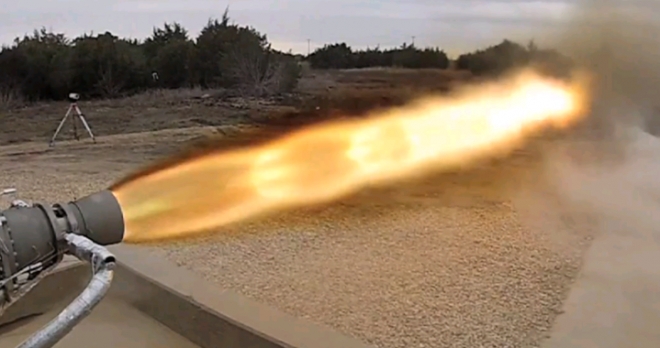
SpaceX’s new rocket motor (for propulsive landings, just like the ones in the scifi stories) has “shock diamonds” in its plume. The phenom was first seen in the 1950s in the exhaust plume of the Bell X-1, the first craft to fly faster than the speed of sound. The “diamonds” are more visible in this video of the motor’s recent test firing (below) in McGregor, Texas, just up the road from the rancho.

SpaceX expanding Texas op

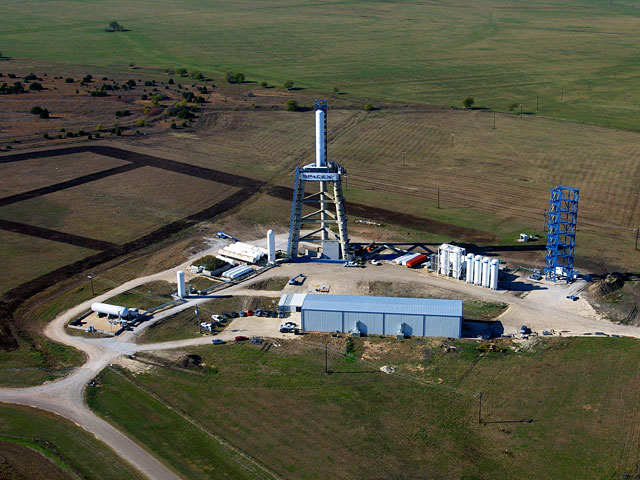
MCGREGOR, TEXAS – Space Exploration Technologies (SpaceX) and the City of McGregor have signed a lease agreement allowing SpaceX to expand the size of its rocket development facility in McGregor—between Austin and Dallas.

Under the deal, SpaceX will lease 631 acres — the equivalent of almost 500 football fields — for its test facility. The new lease will more than double the size of the current 256 acre site on the Western edge of the City of McGregor, and will last roughly 10 years, from February 2011 to January 31, 2021.

“Our Texas rocket development facility is critical to our operations,” said Elon Musk, SpaceX CEO and Chief Technology Officer.  “This lease will allow us to move forward on the growth we have planned for Texas. SpaceX already has more than $2.5 billion in launch contracts for us to carry out over the next few years – McGregor is going to be a very busy place.”

Dragon almost ready to fly

Falcon9secondstage

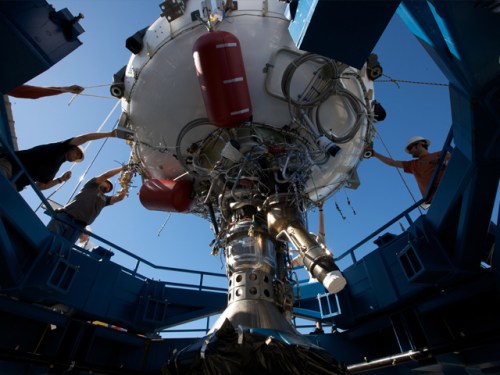
I’ve long thought that the only way we’ll ever get back to Luna to stay or go on to colonize Mars is via private company hardware and work. Here, a SpaceX crew readies the second-stage engine of their Falcon 9 rocket for a successful Jan. 2 test at their MacGregor facility up the road from Austin. The Falcon 9 was expected to fly last fall, lofting the company’s Dragon spacecraft to a rendezvous with the International Space Station. But it’s now expected to begin this spring. The liquid-fueled Falcon 9 and Dragon will replace NASA’s retiring space shuttle.

Falcon 9 moving along

F9QualTank2.JPG

McGregor, TX (July 29, 2009) – Space Exploration Technologies (SpaceX) announces the successful completion of qualification testing for the Falcon 9 launch vehicle first stage tank and interstage. Testing took place at SpaceX’s Texas Test Site, a 300 acre structural and propulsion testing facility, located just outside of Waco, Texas. [First stage is green; interstage is black; this is the bird that will service the International Space Station when the shuttles are retired.]

UPDATE: But I’m opposed to government handouts for these and other commercial ops. We can see how well that worked for NASA, whose proposed Ares 1–whose capsule spacecraft is a throwback to Apollo and doesn’t even have an airlock–already is seeking more tax billions.

Falcon 9: It is Rocket Science

The first launch of SpaceX’s heavy lift vehicle, Falcon 9, may be delayed until fall, but its Falcon 1’s orbiting of a Malaysian sat ten days ago was a plus. Fun to have their Merlin engine test facilities just up the road in McGregor, southwest of Waco.

Might not be if they were rattling our windows, but they don’t do tests very often. Since their founder Elon Musk is the co-founder of PayPal, I hope my use of that service helps SpaceX, too. Falcon 9 was designed from the start to fly a four-man crew and service the International Space Station once the shuttles are retired.

Good luck, guys. It might not be in your plans but I hope you can beat the Indians and Chinese to the moon.