Tag Archives: World War II

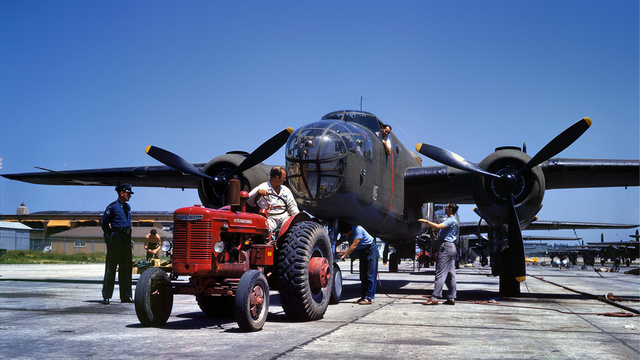
B-25 Mitchell bomber

B-25

Proof, in case any was needed, that World War II was not fought in black-n-white by aged segregationists, homophobes and sexists masquerading as “the greatest generation,” but actually by the young and middle-aged in Kodachrome color.

The rest, unfortunately, is true, except the “greatest generation” twaddle invented by a biased television news reader who has, mercifully, retired. Not that I ever watch his former employer’s contemporary nonsense anyhow.

Via Shorpy

Easter 1944

Command performance dawn religious service and staged publicity photograph, Easter 1944, at Hendricks Field, Sebring, Florida, where my father was then a student pilot in the B-17 bomber.

A few months later, he moved on to Kansas for pilot training in the B-29. I, who was but two months old at Easter, 1944, went back to Sebring in 1974 as a journalist covering the Sebring international auto races.

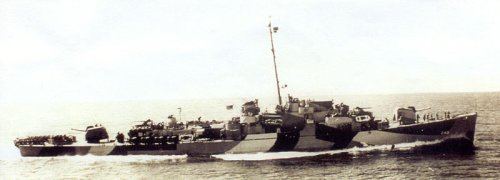
USS Abercrombie

USS Abercrombie DE 343

Sunk on purpose by Navy Skyhawks in 1968, she lies somewhere on the bottom of the Pacific off Baja, CA. But while she lived, as related in Little Ship Big War, The Saga of DE343, she was a microcosm of World War II and its civilian and professional sailors.

Even down to her irascible captain who fled her, unceremoniously, in the midst of the nightmarish Okinawa campaign in which she fought off sixteen kamikaze attacks. All deftly explained by one of her officers turned author Cmdr Edward P. Stafford. Well worth the read.

One truly amazing thing about the book is that it was originally published in 1984. You’d never know it by the prose. Nothing seems dated. Amazon is selling used copies of the 2000 edition, but mine looks new.

Little Ship Big War

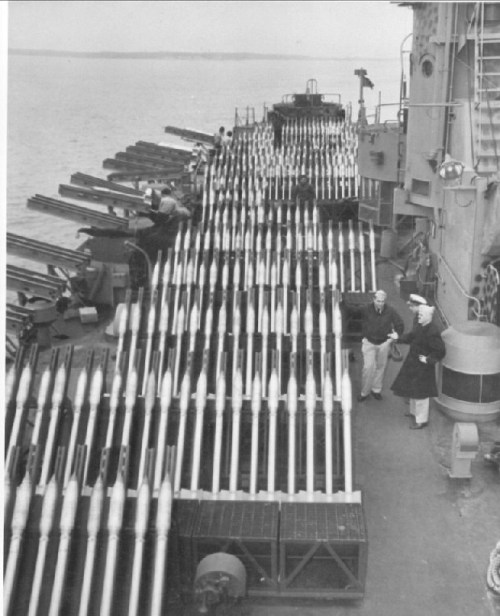
LSMR-ADeck view of an LSMR, from this hobbyist’s page. New stuff to me, these special ships carrying rockets to support troop landings, encountered in Little Ship Big War, The Saga of DE343, by Edward Peary Stafford.

Good book it is, with much day-to-day detail of life aboard a destroyer escort in the last months of World War II. I had no idea, for instance, that the infamous kamikazes did not just dive down on a ship, but also came in low, on the water, to collide with the front, back or side of a ship At Okinawa, there were twin-engine suicide bombers,  suicide boats, even suicide swimmers with bombs. Japanese jihadis!

DE343, the USS Abercrombie, was named for a Devastator pilot shot down at Midway. His namesake ship saw a lot less action, but when it did it was hair-raising. Stafford also wrote The Big E, a newly republished 1964 bestseller which I may read next.

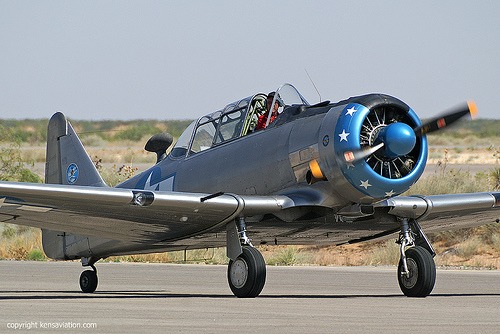
AT-6 Texan

AT-6 Texan Private version of the Texan (distinguishable from the Harvards sold to UK, NZ and Canada by its lack of an exhaust pipe extension from the cowling) the ubiquitous pilot trainer of World War 2.

PT-19 trainees

Cuero_TX_PT-19_pilots_1942.jpg

It never gets this cold in Cuero, southeast of Austin, but these boys are headed to altitude in open cockpits. Taken at the former Cuero Army Air Field in 1942 when this was basic pilot training. I do not subscribe to the "greatest generation" baloney, which I think mainly scorns Korea and Vietnam veterans, but it’s for sure these guys had to deal with some fairly primitive technology. They were just lucky to have the almost complete backing of the whole country during their war.

As We May Think

I’d heard of this classic essay by Vannevar Bush (who was apparently unrelated to the later presidents) a few times but never read it until recently. Written in 1945, it summarizes some of the ways in which science helped win World War II (without getting specific about radar or much else, however) and what it will do in the future.

VB seems to predict the desktop computer, a Windows-like operating system (graphical user interface) and Google-type search engines: "Wholly new forms of encyclopedias will appear, ready made with a mesh of associative trails running through them, ready to be dropped into the memex and there amplified." Even digital photography gets a hint or two. It’s long, at twenty-two pages, and the sexism of the day is jarring, but it’s still worth the effort.