Category Archives: Library

In Turkey the village rules

I don’t normally read detective fiction but I have long enjoyed the work of independent novelist David Chacko. So I picked up (digitally, on my Kindle) his 2008 Devil’s Feathers about a gruesome murder in a tourist town on Turkey’s Aegean coast.

I was rewarded, as always with David, with another good story superbly told and happy to see that the main character, Istanbul Police Inspector Onur Levent, is the subject of a series. That’s worthwhile because of my other reason for reading: to hear from David/Onur about Turkey’s unfortunate slide from Western sophistication to Eastern fundamentalism. It seems to be only skin-deep.

The modern Islamic state, which supplanted the older secular regime I knew as a teenager living in Ankara in 1961-63 (though it can still be glimpsed, at least in the novel, in the occasional framed office photograph of reformer Ataturk in evening dress) is worth understanding because its fundamentalist Islam has turned it from ally to antagonist of Israel and, by extension, of the Big Satan as well.

The turn-around, like the Islamic parties themselves, Levent informs us, are the result of the political rise of the rural village, where misogynistic (and presumably anti-Semitic) tradition has been reinforced by Koranic injunction. But the fundies still put up with teeny bikinis at the seaside for the foreign currency to supplement their older smuggling of drugs and etc. Thus Levent and his wife Emine represent the secular Turkey that still survives, clinging to what’s left of sophistication while taking care not to go too far. As such they are good guides to the new reality.
Some great music for pennies a pop

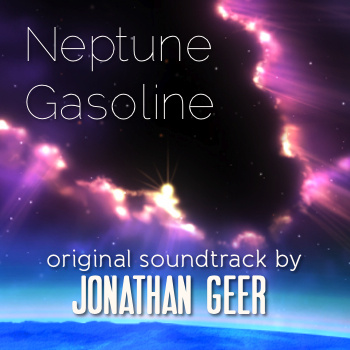
The computer game Neptune Gasoline never made it to production but that certainly wasn’t Jonathan Geer’s fault. My favorite Austin pianist/composer has done more than a few game soundtracks (thirteen so far) and Neptune Gasoline was one of his better efforts.

Fortunately, even if the game cratered, the music still is available in MP3 format at pennies a pop. My favorite there is A Thousand Light Years at 3:32 for a mere 89 cents, or more if you want to be generous and help out a talented guy who has the proverbial bright future ahead of him, shades and all.

Or try Eye of The Pond at 2:02, from Jonny’s soundtrack for Sparkle 2, an arcade puzzle game that is apparently pretty popular.

And don’t miss JG’s score for the PC adventure game OwlBoy, when it becomes available. No MP3s for sale yet, but you can preview the main theme of the really cool music here on YouTube.

GK for saint?

From a 1921 interview British author G.K. Chesterton gave the Cleveland Press:

“The men whom the people ought to choose to represent them are too busy to take the jobs. But the politician is waiting for it. He’s the pestilence of modern times. What we should try to do is make politics as local as possible. Keep the politicians near enough to kick them. The villagers who met under the village tree could also hang their politicians to the tree. It’s terrible to contemplate how few politicians are hung today.”

Q: How can you tell when a politician is lying?
A: His lips are moving.

These days some Catholics want to make GK a saint. Works for me.

Why the Dems hate Fox News

Because of little gems of actual journalism like this Neil Cavuto find of a video of JFK endorsing a tax cut to get the economy moving again—in 1963!

“I’m in favor of a tax cut because I’m concerned that if we don’t get the tax cut that we are going to have an increase in unemployment and that we may move into a period of economic downturn.”

This was never rocket science, not even to the pol who won the presidency with a phony campaign about a “missile gap” with the Soviets. Kennedy was never as saintly as the Democrat media and academics have made him out to be since his murder.

But cutting taxes and cutting back on federal regulations used to be the mantra of both parties when the economy was in the tank. Until Obongo and Reid and Pelosi. They’ve rather see the little people on food stamps, the better to control their votes, and, meanwhile, hold rich people’s feet to the fire—not to do them actual harm, just to force them to pony up more of the bribes Obongo, Reid and Pelosi (and their media pals) like to call “campaign contributions.” Skunks.

Via Darkwater.

Nifty new map

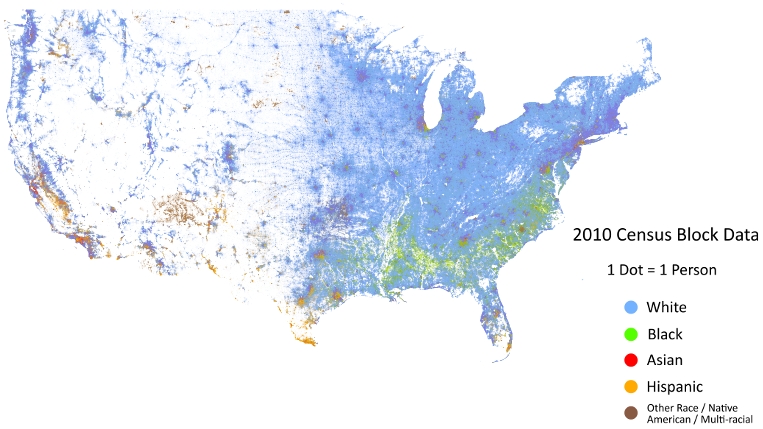
An interesting, counter-intuitive map of the 2010 federal census. Counter-intuitive because a) it shows most Americans are white (despite news media emphasis and fact that most advertising features black models and out-of-work black actors); b) blacks still live mainly in the South; and c) there’s still lots of empty space in the West. Click to biggerize.

I suppose had the millions of Hispanic illegals been counted, there’d be more orange than there is, but what orange there is shows that most of the legal Hispanics still reside in Texas, New Mexico and southern California. Not sure why Alaska and Hawaii were left out. They’d certainly have a lot of brown and red.

UPDATE: James Taranto on the blacks in the South phenom: “Now, why would blacks move out of big cities in the Northeast, the Midwest and California and into the South and the suburbs? In part for the same reasons nonblacks do: in search of better economic opportunities and quality of life. But also because the factor that drove blacks in particular to leave the South no longer exists. Jim Crow is now long dead, but it had been dead a decade at most by the time the New Great Migration began.”

The Jewish Cemetery at Newport

Henry Wadsworth Longfellow’s poem on the 1677 Sephardic burying ground in Newport, Rhode Island:

How strange it seems! These Hebrews in their graves,
Close by the street of this fair seaport town,
Silent beside the never-silent waves,
At rest in all this moving up and down!

The trees are white with dust, that o’er their sleep
Wave their broad curtains in the southwind’s breath,
While underneath these leafy tents they keep
The long, mysterious Exodus of Death.

And these sepulchral stones, so old and brown,
That pave with level flags their burial-place,
Seem like the tablets of the Law, thrown down
And broken by Moses at the mountain’s base.

The very names recorded here are strange,
Of foreign accent, and of different climes;
Alvares and Rivera interchange
With Abraham and Jacob of old times.

“Blessed be God! for he created Death!”
The mourner said, “and Death is rest and peace!”
Then added, in the certainty of faith,
“And giveth Life that nevermore shall cease.”

Closed are the portals of their Synagogue,
No Psalms of David now the silence break,
No Rabbi reads the ancient Decalogue
In the grand dialect the Prophets spake.

Gone are the living, but the dead remain,
And not neglected; for a hand unseen,
Scattering its bounty, like a summer rain,
Still keeps their graves and their remembrance green.

How came they here? What burst of Christian hate,
What persecution, merciless and blind,
Drove o’er the sea -that desert desolate –
These Ishmaels and Hagars of mankind?

They lived in narrow streets and lanes obscure,
Ghetto and Judenstrass, in mirk and mire;
Taught in the school of patience to endure
The life of anguish and the death of fire.

All their lives long, with the unleavened bread
And bitter herbs of exile and its fears,
The wasting famine of the heart they fed,
And slaked its thirst with marah of their tears.

Anathema maranatha! was the cry
That rang from town to town, from street to street:
At every gate the accursed Mordecai
Was mocked and jeered, and spurned by Christian feet.

Pride and humiliation hand in hand
Walked with them through the world where’er they went;
Trampled and beaten were they as the sand,
And yet unshaken as the continent.

For in the background figures vague and vast
Of patriarchs and of prophets rose sublime,
And all the great traditions of the Past
They saw reflected in the coming time.

And thus forever with reverted look
The mystic volume of the world they read,
Spelling it backward, like a Hebrew book,
Till life became a Legend of the Dead.

But ah! what once has been shall be no more!
The groaning earth in travail and in pain
Brings forth its races, but does not restore,
And the dead nations never rise again.

Henry’s usual musical rhymes, of course, but obviously not at his most prophetic…

I still love my Kindle 2

But like Scott at the Fat Guy, I probably will get a Kindle Paperwhite when the 2 finally bites the dust. Richard Fernandez, as usual with him, has a nice little essay on why he loves his Paperwhite, with only this little proviso:

“The biggest benefit of the readers, I’ve found, is that you can shift between volumes. When the classics get too heavy you can always switch to something more tradesman-like. But perhaps that is properly considered, a disadvantage. The one thing the old timers had on us is they had so little in the way of portable information they were forced to discover drama in nature or find it in their own thoughts. They preferred poetry because verse is compressed; full of suggestion, not exposition.”

I would only add that I have bought more books with the 2 than I ever did in paper. I love the ease of buying, even from on my back in bed, and the dictionary for checking the meanings of words. The Kindle is even searchable! Zounds.

Via The Fat Guy