Category Archives: Science/Engineering

Chinese sat killer?

The Chinese apparently have developed a missile that can attack satellites as far as 530 miles into the black, according to Aviation Week & Space Technology:

"Details emerging from space sources indicate that the Chinese Feng Yun 1C (FY-1C) polar orbit weather satellite launched in 1999 was attacked by an asat system launched from or near the Xichang Space Center."

Interesting, of course, and probably important, but it’s hard to believe the Chinese would want to upset their biggest world market, i.e. us, with an attack on our satellites, when the rest of their military ain’t much to crow about. 

Water intoxication

A young mother in California is dead from water intoxication in a radio station’s competition trying to win a Nintendo Wii video game system for her children. This caught my eye because I’m back on the induction phase of the Atkins diet, which means drinking about 80 ounces of water a day. The difference is I take time to urinate and that was exactly what the competition specified you could not do, while drinking quarts of water. Somebody’s going to be sued, according to the science blog Respectful Insolence:

"Allthough I do not discount individual responsibility, most people are ignorant of how little it can take to cause water intoxication. It is not stated whether (1) contestants were warned that they could die from drinking too much water too fast or (2) qualified medical personnel were present to monitor the contest. In addition, it doesn’t say whether the radio station had vetted its idea with a physician. I doubt that it did, because any competent physician would have told the organizers that this contest was a very bad idea and dangerous, to boot."

Some doctors also think the Atkins diet is dangerous, but I have not found it so. YMMV.

McNaught brightening

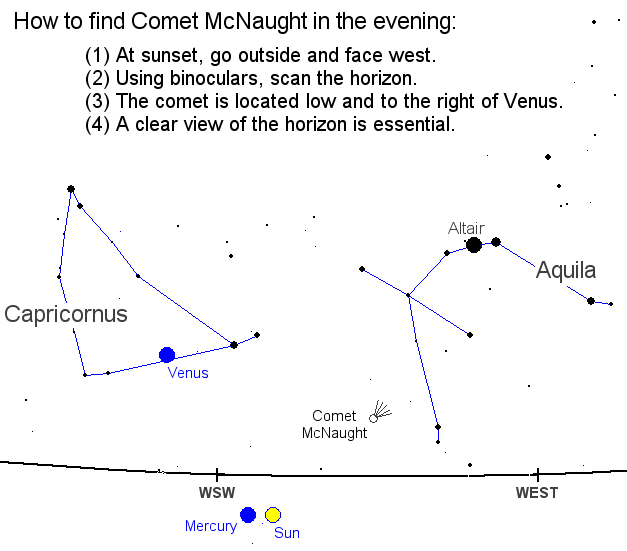
Comet McNaught is brightening so much as it nears the sun–the heat making the rocky snowball vaporize furiously–that it is becoming visible in daylight, which could make it the brightest one in centuries. Tricky to find, though, because it’s close to the sun. Spaceweather.com advises: "Go outside and stand in the shadow of a building (or billboard) so that the glare of the sun is blocked out.  Make a fist and hold it at arm’s length.  The comet is about one fist-width east of the sun." Bincoulars will allow you to see the structure within the comet’s tail, but be careful not to look at the sun. You don’t want a black (burned) spot in your eyes forever after. Comet pix here to see what you’re looking for.

Brightest comet in thirty years

Richard1.jpg

This could be the best night to see Comet McNaught (C/2006 P1), brightening as it speeds towards the sun. It’s visible both at sunset and at dawn if you have a clear view of the horizon. At sunset, it shows up in the twilight as soon as the sun is down. In the morning, it emerges just before the sun rises. Looks even better in 10X50 binoculars. More images here./photo over Johnston, Iowa last night by Stan Richard, Iowa Public Television.

Dark matter mapped

Darkmattermap.jpg

3D map by Hubble Space Telescope (in lower left corner) shows clumpy nature of cold, dark matter which is invisible but accounts for most of the Universe’s mass. Its gravitational attraction pulls normal matter–the stars in their galaxies–into the large-scale structures seen through telescopes.

Stopping cancer’s spread

New device invented at University of Rochester and being commercialized has potential for stopping the spread of cancer by filtering the blood for renegade cancer cells:

"When someone has a primary cancer tumor, a small number of cancer cells circulates through the bloodstream.  In a process called metastasis, these cells are transmitted from the primary tumor to other locations in the body, where they form secondary, cancerous growths. 

"As a cancer cell flows along the implanted surface, King’s device captures it and delivers an apoptosis signal, a biochemical way of telling the cancer cell to kill itself.  Within two days, that cancer cell is dead.  Normal cells are left totally unharmed because the device selectively targets cancer cells."

Via Doc In The Machine

Today’s pretty picture

OrionBeltx_demartin_f45.jpg

A closeup of the stars in the Belt of Orion the Hunter, my favorite constellation, and the only good thing about winter (for me), except for the fact that in Texas, at least, winter is rarely longer than six weeks. The worst part is in January, which is about to begin. Oh, well, it’s short./ NASA.