Category Archives: Space

Wright’s Chaos Chronicles and Hermetic Millennia

Science Fiction and Fantasy author John C. Wright is quite the storyteller. I recently finished his new Hermetic Millennia (the sequel to his scifi Count To A Trillion) wishing the third book (of a projected five) was already done, instead of having to wait a year or more for the continuation of this series on interstellar travel and human evolution. A Tex-Mex gunslinger hero also doesn’t hurt.

Last night I finished Orphans of Chaos, the first book in an earlier fantasy collection of his and immediately moved on to its sequel Fugitives of Chaos, with just as much anticipation as for the science fiction, though in a different way. The Chaos stories are a sort of Harry Potter for adults enlarged by the physics of relativity and theories of multiple universes.

I  had previously read his Golden Age series, space opera mixed with hard science, chiefly about biotechnology and networked computers.

All these books are informed by Wright’s seemingly immeasurable imagination, his mathematics, astronomy and literary education, his love for Greek myth, the history of religion, and (delight of delights) a Libertarian political sensibility you don’t often find in scifi or fantasy nowadays. Leftists beware.

I could say more, but you get the idea. Don’t except an easy read. Wright packs more ideas into a paragraph than most authors do into a whole story. But do try the books, you won’t be sorry.

The right to self-defense

It’s presidents like Barry and their overweening insistence on imposing their private opinions on the rest of us, by executive order if Congress can’t be pushed to do their bidding, that calls to mind the real reason for the Second Amendment to the U.S. Constitution.

It was not just about raising a militia, or about hunting for one’s supper, or even stopping a tyrannical government, but for the right of self-defense, a privilege theretofore guaranteed only to the aristos of the social elite.

Their modern descendants are trying hard now to reclaim the privilege for themselves alone via such excuses as  mass murderers like the evil bastard who slaughtered the children in Newtown. He shot each child separately, one trigger pull at a time.

That’s the definition of semi-automatic, one trigger pull per bullet, the latest proposed excuse for gun control, though it’s a feature of weaponry that’s been around more than a hundred years. Revolvers don’t strictly meet the definition but they do the same thing, bringing a new round into ready position after each pull of the trigger. Just like the evil SOB’s military-lookalike, semi-automatic Bushmaster rifle. Only a lookalike.

But self-defense is the crux of this post. Denial of the right to the masses is well expressed in Count To A Trillion, a recent fine space opera by John C. Wright, whose sequel was released in December. Reading the sequel I realized I’d forgotten the first book and so I’m reading it again. Hence this passage I want to quote:

“But it was the fact,” the main character Menelaus Montrose is thinking about life on Earth in 2400, “that the people among the crowds outside [the castle] did not wear those sashes or baldrics…none of them could carry a weapon, drunk or sober. The members of the upper class…or soldiers in their employ or retainers in their service, only they could bear arms…The fact that this world was one where not all men had the right to self-defense was one he deeply resented. Resented? No, it was a hatred, so black and primal…”

And later on he has an epiphany, reading a censored history in electronic form, realizing how easy it is for a politico to alter electronic text:

“Montrose decided then and there that a full library, one made of old-fashioned paper books with bindings, the kind that cannot be electronically re-edited by anonymous lines of hidden code, was just as much a necessity for a free man as a shooting iron….”

It’s as fashionable as ever these days to complain about our fractured, contentious society, a meme I remember hearing in slightly different form as a child way back in the dark ages of the 1950s, and it was even so back in the late 1700s when the Constitution was written.

This time, however, the dispute is over the increasing power of government, particularly federal government, and the megalomania of presidents like Barry, whose support for gun registration and other forms of control is forcing more and more of us to decide that we do not want to live in a world where only the elite can bear arms (or hire it done for them) and ebooks can be altered by sellers at their or a government censor’s whim.

UPDATE:  If Illinois Dems get their way, self-defense with guns will be a thing of the past there. Except for the aristos, of course, who’ll be exempted in one way or another. Wait and see. And the criminals will be armed as always, naturally.

We’re all astronauts

It amuses me every time I see or hear of some child claiming to aspire to become an astronaut. The poor thing doesn’t realize we’re all astronauts, back to the oldest generation and ahead to our farthest descendants.

What else could we be, denizens of a water world shining by reflection of Sol, our system’s sun, and sailing around it in the black void at 18.5 miles a second. Good thing we can’t feel the speed, I suppose, but not being able to only increases our blindness to what is really going on. Where we really are, have been and will be—space travelers all.

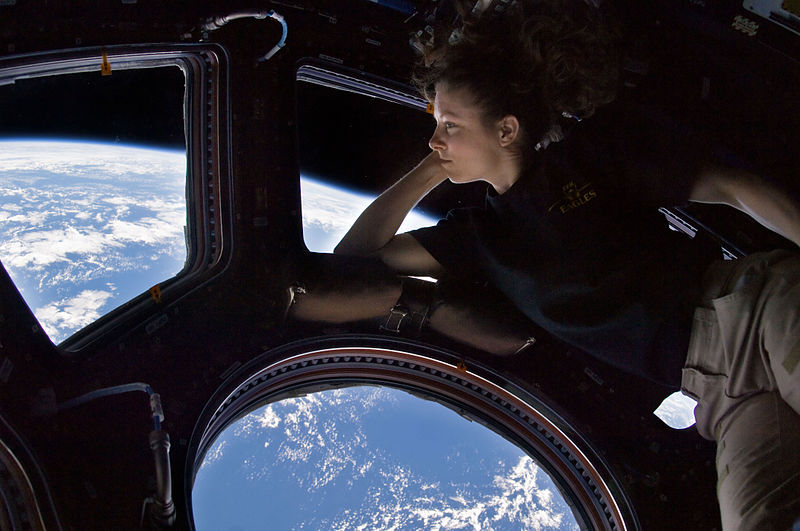
Rule 5: Tracy Caldwell Dyson

She’s cute, for a woman astronaut, a breed who tend to be bland, but I admit it was the spectacular view that really got me to post this. The home planet, our water world: big blue, remembered earth shining, shining in the black.

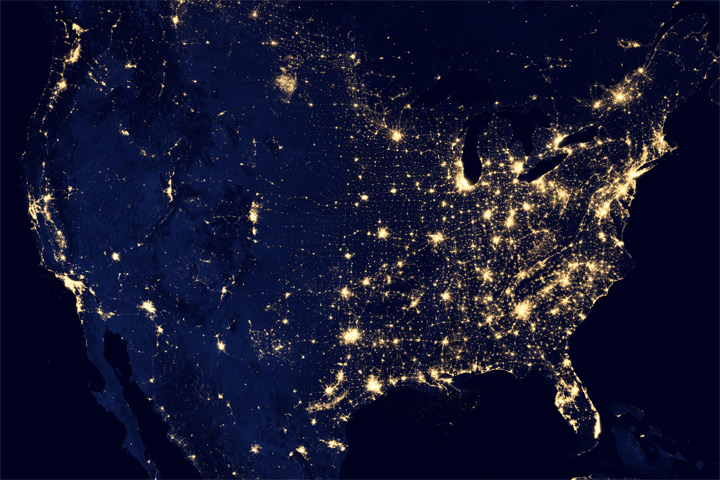
North America at night

This is the latest satellite snapshot, a composite from April and October, 2012, by the Suomi NPP sat, which also recorded this thirty-second video of the whole earth at night. Be interesting to redo the snaps after Barry’s war on coal hikes the price of electricity for everyone. I would expect a noticeable diminishment of these lights.

Neil Armstrong buried at sea

I had no idea. Shows what happens when you ignore most of the media most of the time. The first moonwalker, who performed that feat in July 1969 when I was rather preoccupied on patrol in Vietnam, died at 82 in August.

I knew that part. I didn’t know he was cremated and his “ashes” and “dust” were buried at sea in the Atlantic somewhere off Florida. Probably directly east of the launch pad, though it doesn’t say.

Meanwhile, a day or so after the retired Endeavor space shuttle flew by McGregor, Texas, on its 747 carrier, Space X tested its Grasshopper, a vertical landing space vehicle, there. For now, it’s the first stage of X’s Falcon 9 powered by a Merlin engine—and the classic scifi image of the landing space rocket. If they ever do succeed at making that routine, we’ll know our space future is on the way.

Mars we’re onto you, again!

And how. Lots of fun watching NASA-TV on the Web via C/Net as the new robot Curiosity—about the size of an Austin Mini Cooper automobile—touched down on the Red Planet thirty-nine minutes after midnight Sunday here, or about 3 p.m. Martian time.

A gentle touchdown, apparently, as Curiosity quickly sent back the first photos of one of its wheels and the distant Martian horizon. They were relayed to Earth through Odyssey, another NASA robot in orbit—since 2001.

Curiosity is a one ton, mobile chemistry lab and it landed in a basin crater called Gale which is believed to contain sediments washed downhill a long, long time ago that may contain… Who knows? We’ll be finding out in the next two years and, probably, even longer.