Category Archives: Space

Sleepy sun awakening

Or so it has seemed since sunspots began returning back in December. Too late, apparently, to hinder the Arctic cold snap that put much of the northern hemisphere in the deep freeze until recently.

If, that is, you accept the cosmic ray theory of climate change. Many scientists don’t. Meanwhile the  sunwatchers among them also aren’t ready to declare the end of the solar minimum just yet. In the last few years, the sun has amply proved how little we know about its behavior.
Flyby

mysteryobject

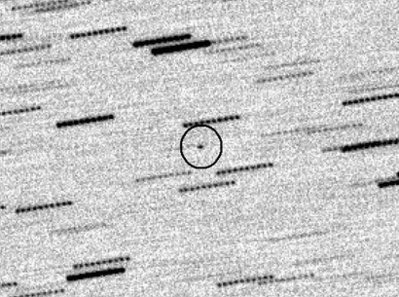
This mystery object from space is expected to whiz by Earth at a distance of about 130,000 kilometers tomorrow. Scientists are stumped by the object, which is 33- to 50-feet wide at most. It’s catalogued as 2010AL30, a 10-meter class asteroid. But who knows. It might be our own space junk. Or an alien probe, perhaps. Even a scout ship? Photo seen from the Skylive-Grove Creek Observatory in Australia.

MORE:  The Daily Astronomer speculates on what 2010AL30 could be

Godspeed

Wonderful tale, this hard scifi novel of the hard times of the planet Erin, whose Irish inhabitants came from a monocultural, multigeneration starship trek. I stayed up late finishing it. Did find it amusing that the back cover synopsis compared it to Robert Louis Stevenson’s Kidnapped, when it’s obviously mimicking Treasure Island in most ways. Captain Shaker is a very credible Long John Silver and Jay Hara a Jack Hawkins in hard vacuum. It’s a great pity that physicist-author Charles Sheffield has passed on. He was a very entertaining story teller.

Dragon almost ready to fly

Falcon9secondstage

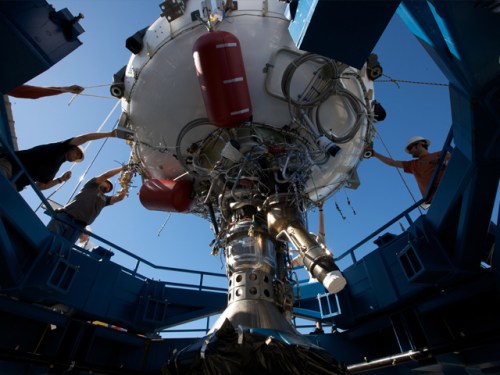
I’ve long thought that the only way we’ll ever get back to Luna to stay or go on to colonize Mars is via private company hardware and work. Here, a SpaceX crew readies the second-stage engine of their Falcon 9 rocket for a successful Jan. 2 test at their MacGregor facility up the road from Austin. The Falcon 9 was expected to fly last fall, lofting the company’s Dragon spacecraft to a rendezvous with the International Space Station. But it’s now expected to begin this spring. The liquid-fueled Falcon 9 and Dragon will replace NASA’s retiring space shuttle.

Hot Jupiters

LithoArtKepler2-br

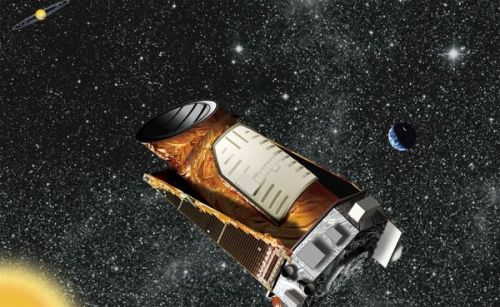
The Kepler telescope’s first five discoveries ain’t hardly habitable, which is its purpose: To find planets we might live on around distant, Sol-like stars. The five (four massing larger than Jupiter and the fifth about the size of Neptune), are high-temperature bodies. Earthlike habitables will come down the road if there are any to be found. Presumably there are, though getting to them may forever be impossible. Unless science fiction’s “hyperspace” turns out to be real and we can use it to travel many light years in a short time. Or “cold sleep” works. The tales of multi-generation spaceship passages to the stars rarely turned out well.

Go see Avatar? Why be a sucker?

Dances With Wolves in space, it’s been called. Or worse. Another waste of money from the PC crowd:

“Lacking the conflict and flaws that make the Indians so fascinating and tragic, the Na’vi are utterly boring…the childlike environmentalist daydream of a ‘perfect’ society, sustainably at peace with Mother Nature, is captured in the image of the Na’vi tribe snuggled in hammock-like leaves, embraced by the vast branches of their goddess tree. No ambitions, no failures, no questions, no achievement, no future. These giant blue aliens leave absolutely no carbon footprint.”

Created by people who wouldn’t live this way if they could. Doctor Zero: the ultimate suicide fantasy.

UPDATE:  It makes the Marines look bad? What, an anti-military Hollyweird flick? Now there’s a surprise.

MORE: It lost out in the Oscars to a low-budget Iraq war movie, ironically, and even more ironically, the war flick was directed by the ex-wife of the Avatar director. Heh.

The Local Fluff

The Voyager spacecraft, still traversing the outer limits of the giant gas bubble we live in, have measured the magnetism of a nearby interstellar cloud and its implications:

"The fact that the Fluff is strongly magnetized means that other clouds in the galactic neighborhood could be, too. Eventually, the solar system will run into some of them, and their strong magnetic fields could compress the heliosphere even more than it is compressed now. Additional compression could allow more cosmic rays to reach the inner solar system, possibly affecting terrestrial climate and the ability of astronauts to travel safely through space."

The researchers conclude: "There could be interesting times ahead!" That’s a given.