Category Archives: Library

The Wanderer: The Last American Slave Ship and the Conspiracy That Set Its Sails

The title of this fascinating work is a phony, as journalist/author Eric Calonius makes clear in his text. The truth seems to have been too much for his New York publisher to bear. That is the author’s sidebar unveiling of the little known late 1850s business offices of slave traders in New York City and their slave ships  down at the wharves of Lower Manhattan.

Calonius shows how these Yankee slave dealers gathered their capital from Northern businessmen and sent their ships to West Africa to buy African slaves low and then sell them high in Cuba and the Caribbean. Then they hosed down their Middle Passage decks and steamed home to New York.

All under the disinterested eyes of corrupt port officialdom (despite federal law making American slave-trading a crime punishable by death). The focus on the Wanderer and the thundering editorials by The New York Times against the few Southern hot-heads who took it to the mouth of the Congo River for slaves and then back to Georgia therefore seems disproportionate as well as hypocritical.

The author smartly weaves the Wanderer tale in with the 1850s politics of North and South and other events, such as the John Brown raid, that precipitated the Civil War. The tracing of the descendants of one Wanderer slave is a nice touch. Would have been better, though, to have included a few of the unwilling passengers of the more numerous New York slavers who continued to operate well into the war. You know, the war supposedly fought to free the slaves.
Knoxville 1863 review

My Israeli friend “Snoopy the Goon” (he prefers anonymity on the Web) has written a nice review of my Civil War historical battle novel and posted it on his blog with links to the Amazon sales page and the book’s new blog, “Knoxville 1863, the novel.”

Thanks, Snoop. Considering that you don’t normally like military history (and that you even had to Google Tennessee to see where Knoxville was), I admire your persistence and I’m very pleased that you enjoyed the story.

The I had no idea department

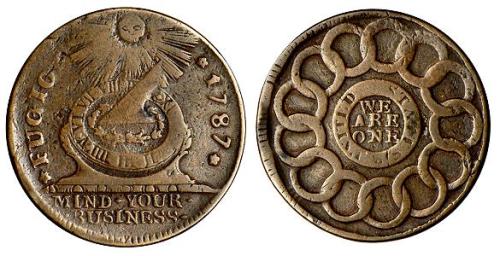
stacks_new_fugio_reverseReading a new non-fiction book on the slave trade, I came across the interesting assertion that shillings and pence were still in general use in the South in 1838, because the only American coins were these fugios, or Franklin cents. The thirteen rings are cool, but I love “Mind Your Business.”
Vitals

This is one paranoid hard SF novel by Greg Bear. A clear majority of his Amazon critics seemed to hate it. I rather enjoyed it, but it certainly was a weirdie. Did you know Stalin was still alive, barely, in a bacteria-filled tank in Manhattan?

Good thing I’m not a conspiracy buff, into things like government mind control. Otherwise I could be losing sleep over this one. Instead, I always remember the words of an old friend who retired from fed law enforcement: “They (the feds) couldn’t find their own posterior with both hands.” Or the Russians, either, who are the real bad guys in this one.

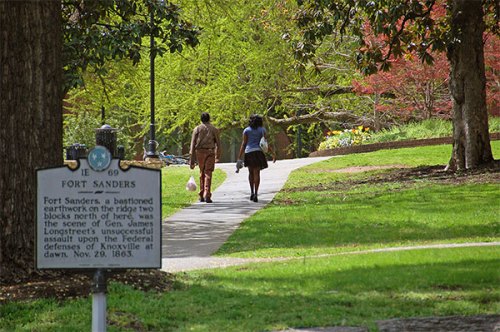
All that remains of Fort Sanders

ftsanderssm

Just a historical marker two blocks south of the military crest of the ridge. I posted this on the novel’s Web site as well. Will post it here also to give the novel site a little boost. It is not yet attracting as many hits as the 13th MS one, which is understandable I suppose. The MS brigade was famous and still is among the war’s buffs. Fort Sanders was, at best, obscure. Forgotten is even more accurate. That was my gamble novelizing it, but also my opportunity.

The Seablogger on cancer

Divide and Conquer
The cells divide. The cells that will not die
divide too well and so they multiply.
They kill the host to keep themselves alive.
The blood goes bad. In vain physicians try
to purge the veins with drugs the cells defy.
The cells divide. The cells that will not die
mutate anew. The hardy few survive.
The few recruit the many teeming by.
They kill the host to keep themselves alive.
They colonize the nodes from neck to thigh.
The tumors grow, and scanners never lie.
The cells divide. The cells that will not die
stifle the very organs where they thrive.
Blind, stupid things—their purpose gone awry—
they kill the host to keep themselves alive.
Exploding through the flesh, they multiply,
but immortality eludes them. Why?
The cells divide. The cells that will not die
kill the host to keep themselves alive.

Good stuff. The fitting end to this good interview by his longtime partner. Too soon he died. Yet, as he says there, he could be proud of what he left behind.

Darwin’s Children

I enjoyed this sequel to Greg Bear’s Darwin’s Radio—only about $12 for both on the Kindle. The sequel was as touching and affective as the first novel. I also appreciated the hard-science plot and the definitions and sources in  the back of DC. I had spent a fair amount of reading time wondering how much of the whole genomic story of the creation of a new sub species of Homo could possibly ever happen all at once like that.

Not much chance, apparently, though Bear makes clear that molecular biologists aren’t all that sure. (Somehow I had overlooked the genetic origin of viruses and that, alone, was worth the price of admission.) I also enjoyed his surprising conjoining of science and belief. Nicely done.

I could have done without the villainy attached to the Republicans and FoxNews. As I recall, when SF masters like Heinlein blamed pols, they did not specify party and used fictitious journalists as stand-ins for the industry.

I wonder why modern SF writers like Bear (and Stross, to name another who also does it) don’t follow suit but, instead, feel the need to push their personal politics in their readers’ faces. Sign of the times, I suppose, or maybe their editors/publishers require it. That wouldn’t surprise me. Still, despite this flaw (neither book wallows in it), both were worthy, absorbing tales I recommend to all.