Category Archives: Science/Engineering

Sense, instead of nonsense

Where are the journalists protecting us from government overreach? What? Leading the bandwagon?

"’The good news is, that it should not take long for the latest environmental scare to join the ‘ozone layer’, ‘global winter’, the Club of Rome forecasts, and many other crocks on the shard-heap of history. The bad is, it will be succeeded by more Chicken-Little expostulations, with the same propagandist theme: ‘Unless the planet is delivered immediately into the iron embrace of the environmental bureaucracies, we’re all going to die!’”

Double heh. 

Saturn views

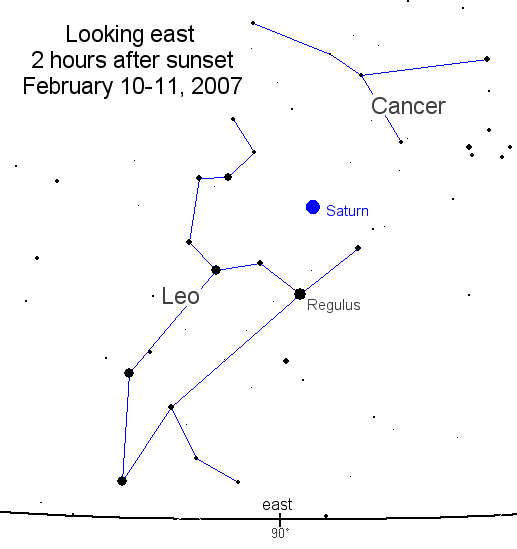
Good views of Saturn possible this weekend with a home telescope, two hours after sunset in the Northern Hemisphere, looking east here until it’s overhead by midnight. Should have a good view of the rings as they are tilting towards us.

From SpaceWeather.com: "Saturn is at its closest to Earth: 762 million miles. It thus looks bigger and brighter both to the naked eye [resembling a bright, yellow star] and through a telescope than it will at any other time in 2007."

Disrupting the lovers’ embrace

I saw the picture of the embracing skeletons on Drudge, read the headline, and moved on to something else. Then I read Belmont Club’s take "Now and Forever" and got more interested. I had not thought of the Romeo and Juliet angle on this presumed 5,000- to 6,000-year-old couple. Nor of their contradiction of Marvell’s poem about how "The grave’s a fine and private place, But none, I think, do there embrace." But I agree with Wretchard’s commentor that it’s a shame the bones were disturbed, and now sit in plastic bags in a warehouse awaiting DNA analysis. So much for now and forever.

Global good?

I linked before to this good essay (with 40 plus comments) by Donald Sensing, but it’s worth doing it again. It answers a good question about Global Warming, one you’re not likely to hear in the doomsday "debate" and furor: What if the warming is a good thing? Rising oceans can’t be good, they say, but they won’t rise in an afternoon, but over many decades, allowing plenty of time to build Dutch-like dikes, for one thing. But what if the warming produced more arable land in the Third World, helping them to feed themselves better than they do now? What if, in other words, Global Warming is a good thing?

181 things to do on the moon

Not a joke list, or even a few of the more serious, yet non-scientific, things I could think of to try in near weightlessness. But a list of scientific things to do, such as studying the color of Earth’s oceans to gauge their health, and analyzing Earth’s atmosphere to learn how it really works. The one I like the best is this:

"A radio telescope on the far side of the Moon would be shielded from Earth’s copious radio noise, and would be able to observe low radio frequencies blocked by Earth’s atmosphere. Observations at these frequencies have never been made before and opening up a window into this low frequency universe will likely lead to many exciting new discoveries."

Read the whole list here

Save the planet

Instapundit has the right idea. Since it’s the politicos, the rockers and the actors and other celebs who are all saddling up on the stop global warming hobby horse, let’s start by banning private jets, and stretch limos, then work down to mammoth SUVs. Make ’em put their own lives where their mouths are.

UPDATE  A Gulfstream II releases 10,000 pounds of CO2 an hour, celebs. You need to fly commercial. 

Hubble’s main camera dies

sombrero_spitzer.jpg

The Sombrero Galaxy in infrared/by Hubble Space Telescope, NASA.  An electrical failure on the Hubble has put its main camera which is responsible for pictures like these out of action until at least 2008 when the space shuttle is scheduled to make repairs on the orbiting telescope.

"The [Advanced Camera for Surveys] actually consists of three sub-cameras that detect and filter light from the ultraviolet to the near infrared. Astronomers can continue to use Hubble’s other instruments – which include the Field Planetary Camera-2 and the Near Infrared Camera Multi-Object Spectrograph – but the loss of its primary camera is being mourned by the scientific community."