Category Archives: Science/Engineering

Dragon almost ready to fly

Falcon9secondstage

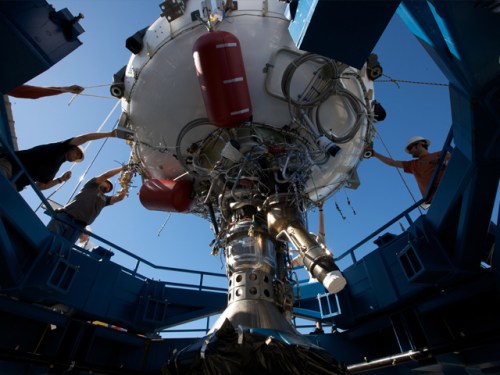
I’ve long thought that the only way we’ll ever get back to Luna to stay or go on to colonize Mars is via private company hardware and work. Here, a SpaceX crew readies the second-stage engine of their Falcon 9 rocket for a successful Jan. 2 test at their MacGregor facility up the road from Austin. The Falcon 9 was expected to fly last fall, lofting the company’s Dragon spacecraft to a rendezvous with the International Space Station. But it’s now expected to begin this spring. The liquid-fueled Falcon 9 and Dragon will replace NASA’s retiring space shuttle.

Hot Jupiters

LithoArtKepler2-br

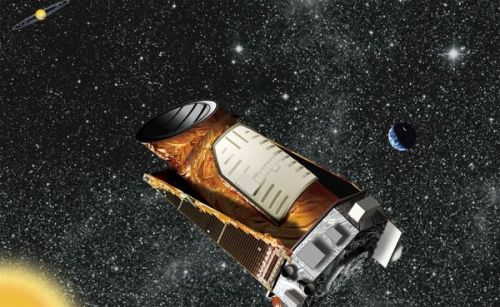
The Kepler telescope’s first five discoveries ain’t hardly habitable, which is its purpose: To find planets we might live on around distant, Sol-like stars. The five (four massing larger than Jupiter and the fifth about the size of Neptune), are high-temperature bodies. Earthlike habitables will come down the road if there are any to be found. Presumably there are, though getting to them may forever be impossible. Unless science fiction’s “hyperspace” turns out to be real and we can use it to travel many light years in a short time. Or “cold sleep” works. The tales of multi-generation spaceship passages to the stars rarely turned out well.

School science project experiments

Whew. The six experiments for Mr. B.’s school science project took four hours. Not counting an hour’s worth of breaks, one of them a trip to the grocery for more supplies.

I hesitate to explain the thing until it’s turned in later this month and the grade is given. Who knows whether the competition might pass through. By then I will be able to post one of the pictures we took in documenting everything and the conclusions we drew.  Said conclusions remaining to be drawn, of course. The data collection was exhausting enough. We continue with the analysis tomorrow and Monday.

I will say that the experiments didn’t turn out the way we expected, probably partly because our methodology wasn’t very precise. Which is one reason I doubt AGW, because of what I’ve read of their methodology, it, too, is far from precise.

Missed the Ole Miss-OK State game, of course. Sorry State was shelacked, 21-7. Maybe it’s as well I missed it. To my Mississippi relatives who follow Ole Miss, congratulations!

Alas that gives the Big 12 a 3-3 record in bowls so far. Hope Tech wins tonight and, of course, Texas next Thursday to make the record a winning one.

The Local Fluff

The Voyager spacecraft, still traversing the outer limits of the giant gas bubble we live in, have measured the magnetism of a nearby interstellar cloud and its implications:

"The fact that the Fluff is strongly magnetized means that other clouds in the galactic neighborhood could be, too. Eventually, the solar system will run into some of them, and their strong magnetic fields could compress the heliosphere even more than it is compressed now. Additional compression could allow more cosmic rays to reach the inner solar system, possibly affecting terrestrial climate and the ability of astronauts to travel safely through space."

The researchers conclude: "There could be interesting times ahead!" That’s a given.

The Gorebot and the mosquitoes

I’ve always figured that old Army journalist Al Gore took one look at the acclaim and money that greeted Michael Moore’s fraudulent documentary on 9/11 and said to himself, "Ah ha, I can do that!"

And he did. And his Oscar- and Nobel-winning Inconvenient Truth is as big a crock as Moore’s opus. But I missed the bit where Gore claims AGW will increase insect-borne diseases such as malaria. The example he used of mosquitoes fluttering their way to Nairobi is wrong. But, in the spirit of MM’s crockumentary, the Gorebot uses it anyway. Of course. Money and fame are the aim.

Meanwhile, for those who find the Gorebot too annoying to spend much time with, there are these hundred reasons why climate change is not man-made. And New Scientist’s rebuttal which, curiously, only addresses half of the hundred reasons. Ran out of space, I guess. On the Net?

AGW critic recovering

Turns out that scientist at the Copenhagen meeting who suffered a heart attack was Henrik Svensmark, author of a plausible book and much research behind it as to what (besides carbon dioxide), might be causing the global warming that may or may not actually be occurring.

Svensmark seems to be recovering from what seems to have been a malfunctioning pacemaker, according to this hard-to-read Google translation of a Danish newspaper account, posted by Anthony Watts. Svensmark believes that a lack of cosmic rays to provide the seed nuclei for the formation of clouds to keep the temperature low is behind whatever warming there is. Sol’s recent sleep apparently has upped the cosmic ray count, which Svensmark might say is bringing the recent early winters.

The Atomic Finger

AtomicFinger.jpg

The Nanoscale world is illustrated by the cantilever silicon tip of an atomic force microscope, just a few atoms wide.

Via NewScientist.